


What is difference between Swing and Seam bowling?
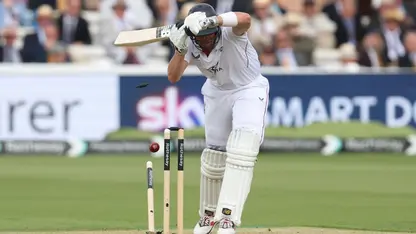

Jamie Smith loses his off-stump (Source: Getty Images)

Published - 04 Jul 2026, 11:34 PM• Read time - 3 mins
Cricket is often called the gentleman’s game, but modern conditions tilt heavily in favour of batters. Flat pitches, short boundaries, and fielding restrictions during the powerplay allow batters to dominate, dazzling crowds with their strokeplay.
Yet bowlers, especially fast bowlers, have had to evolve rapidly to survive. Their survival depends on skills that can outmanoeuvre batters, and two of the most important are swing bowling and seam bowling.
What is swing bowling?
Swing bowling is the art used by fast bowlers and medium pacers to make the cricket ball move in the air after release. This movement happens because of differences in airflow around the ball, created by the way the seam is positioned and the bowler’s grip.
How do pacers make the ball swing?
Pacers grip the ball with the seam angled. If the seam is pointed towards the slip cordon at the moment of release:
- The side of the ball not facing the slips experiences laminar airflow, a smooth flow of air.
- The seam trips the airflow on the other side, making it turbulent.
- The airflow adheres longer to the surface on the side facing the slips, leading to late separation.
- This asymmetry creates a phenomenon known as 'wake' that pushes the ball in the direction of the seam.
So:
- If the seam is angled towards the slip cordon, the ball will swing away from a right-handed/left-handed batter (outswing).
- If the seam is angled towards leg-slip, the ball will swing into the right-hander/left-handed batter (inswing).
Conditions that help swing bowling
Windy conditions are a huge advantage. The stronger the airflow, the more the ball swings, making life extremely difficult for batters.
Masters of swing
Modern exponents include Mitchell Starc and Bhuvneshwar Kumar, while legends like James Anderson and Dale Steyn were masters of the craft.
What is seam bowling?
Seam bowling is the skill used by fast bowlers and medium pacers when the ball doesn’t swing in the air but deviates sharply after pitching. This movement off the surface is called seam movement.
Why is seam bowling dangerous?
Because the ball changes direction after pitching, leaving batters with very little time to adjust. They often play late or misjudge the line, leading to dismissals.
Seam bowling with an upright seam
Mohammed Shami has mastered the upright seam. He presents the seam perfectly, ensuring no deviation in the air, but there is a sharp movement after pitching.
Seam bowling with a scrambled seam
Bowlers like Stuart Broad, Kagiso Rabada, and Mohammed Siraj use the scrambled seam. This makes it extremely difficult for batters to predict which way the ball will move after pitching, forcing them to second-guess until the last moment.
Conditions that assist seam bowling
The way a pitch interacts with the ball after it bounces determines how much seam movement a pacer can extract.
There is a lot of friction on flat wickets with little grass. The ball slows down considerably after pitching due to that friction, which reduces the efficiency of seam movement and makes life easier for batters.
On the other hand, green tops with grass and moisture are ideal for seam bowling. The grass and moisture act as a lubricant, reducing friction when the ball hits the surface. This means the ball retains more pace after pitching, grips the seam, and deviates sharply. Batters have less time to react, which is why seam bowlers love these conditions.