


Eden Park vs ICC Rules: How Auckland venue hosts T20Is despite unique dimensions?
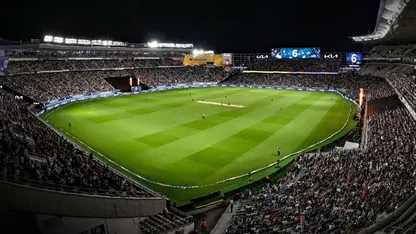

Eden Park, Auckland (Source: X/@BLACKCAPS)

Published - 30 Oct 2026, 05:00 PM• Read time - 2 mins
The venue for the fourth T20I between New Zealand and India has become a topic of discussion due to its odd dimensions. The Eden Park in Auckland has witnessed 34 T20Is so far, after hosting the historic maiden men’s T20I between Australia and New Zealand in 2005.
Over the years, several high-scoring affairs have been played at the ground as the 200-run mark has been breached 13 times.
The peculiar straight boundaries at the ground, which are roughly 52-55 metres long, give batters enough freedom to hit straight and clear them with ease. They were used pretty well by New Zealand batter Glenn Phillips against India, who smashed a 46-ball century.
Notably, the straight boundaries don’t fulfil the criteria under the official playing conditions of the ICC for it to be considered an international ground. As per Clause 19.1.3 of the ICC Men’s and Women’s Twenty20 International Playing Conditions, ‘no boundary shall be longer than 90 yards (82.29 meters), and no boundary should be shorter than 65 yards (59.43 metres) from the centre of the pitch to be used.’
However, there can be some rare exceptions, and any venue that cannot meet the minimum boundary size can apply to the ICC to be considered for an exemption. Since Eden Park was an existing venue prior to the regulations set by the ICC, it remains operational as an international venue under exemption.
How NZ used short boundaries to their advantage?
The odd nature of straight boundaries was used to perfection by New Zealand, who racked up their highest-ever T20I score of 259/7 in their allotted 20 overs. India’s Mayank Yadav and Nitish Kumar Reddy faced the harsh realities of the game as they bowled against the shorter side of the ground with Daryl Mitchell and Glenn Phillips milking them for runs.
While Mayank managed to redeem himself by dismissing Mitchell, Reddy was given no respite by Phillips, who whacked him for 32 runs in his third over. Later, Mayank was again at the receiving end as Michael Bracewell kept using his pace to scoop him for sixes over the short boundary behind the wicket.
However, India couldn’t use the conditions to their advantage and succumbed to the massive scoreboard pressure, being restricted to 172/9. As a result, they suffered their second-biggest defeat in T20Is by 87 runs.