


Was Chris Thurgate’s decision to reverse the wide call in India vs Japan T20I, the right one?
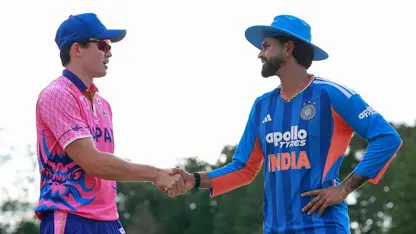

Shreyas Iyer and Kendel Kadowaki-Fleming (Source: BCCI)

Published - 22 Sep 2026, 07:20 PM• Read time - 2 mins
Controversy engulfed the Suzuki Cup, the one‑off T20I between India and Japan played on September 22 to mark 75 years of diplomatic relations between the two countries.
The incident unfolded in the final over after persistent drizzle reduced the match to five overs per side. On a slow, low surface, Japan restricted India to 32 and required six runs off four balls, with Axar Patel operating.
Shirai‑Patmore of Japan attempted a reverse hit and missed completely as the ball spun away on the leg side. Local umpire Chris Thurgate, who had officiated in 17 T20Is and five WT20Is, made a belated wide call.
The Indian players were taken aback, as the decision reduced the equation to six off four balls. The next delivery produced an identical outcome, and Thurgate again signalled a wide.
The call infuriated the Indian players, prompting captain Shreyas Iyer to speak to square‑leg umpire Chris Brown. Brown, an ICC Elite Panel umpire, officiated in 104 T20Is, 16 Tests, 54 ODIs, 13 WODIs and 14 WT20Is, approached Thurgate, who then reversed the wide call.
India escaped a potentially decisive moment and successfully defended the lowest total (32) ever defended in T20 cricket.
Was Chris Thurgate’s decision to reverse the wide call the right one?
Yes, Thurgate’s decision to reverse his wide call was correct.
Under ICC guidelines for wide calls in white‑ball cricket, if a batter attempts a switch‑hit or reverse hit, both sides of the wicket are considered the off side. This means the ball must pass outside the 75‑cm mark from the outer stump (in Shirai‑Patmore’s case, his leg stump) to be called a wide. Even if a batter only shapes for a reverse hit but returns to a normal stance at the moment of delivery, both sides of the wicket are still treated as off side.
Why?
The moment a batter changes his stance, he brings deliveries on both sides of the wicket within reach.
Why was the first wide call of the over not overturned?
Thurgate’s initial wide call stood because India did not protest immediately, and Brown did not have sufficient time to confer with his colleague. However, the fact that the decision remained does not mean it was correct.