


Types of batting shots in cricket
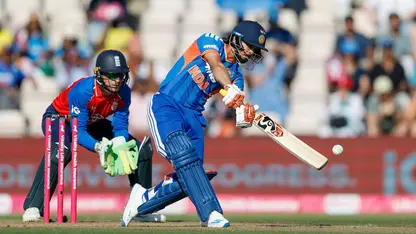

Ishan Kishan tries to launch the ball into the stands (Source: BCCI)

Published - 18 Jul 2026, 08:29 PM• Read time - 4 mins
Batting is one of the three core facets of the game of cricket. The art of batting is about scoring runs and also about survival, depending upon the situation of the match. Batting has evolved over the years, and so has the art of run-scoring. When cricket began, batters had a limited range of shots, and it meant that they could access only certain areas of the field to score their runs.
As cricket evolved, it got divided into three formats: Tests, ODIs and T20Is. As the game condensed into the shorter formats, it became paramount for batters to reinvent themselves and manufacture new shots to stay relevant and thrive. Today, we'll take you through all the different kinds of shots associated with the game and help batters accumulate runs with ease.
Cover drive: A cover drive is a shot played with the full face of the bat towards the fielder standing at cover (a field position). It is considered one of the most elegant shots in the cricketing book.
Straight drive: Another form of drive which is played with the full face of the willow, straight down the ground towards the sight screen where the bowler marks his run up.
Off drive and on drive: Off drive is when the batter plays the ball with a straight bat face towards mid-off, whereas the on drive is also played with a straight bat face but targets the mid-on region.
Square drive: A square drive is played to a ball slightly wide of off-stump. The batter gets the opportunity to free his arms and access the gap between point and cover.
Defence: A defence or a block is played both on the back foot and the front foot. To execute it well, batters tend to keep their bottom hand soft and maintain a vertical arc to prevent the ball from going in the air.
Leave: While many argue whether leave should be categorised into a form of shot, it is extremely essential in ensuring a batter's survival. A leave helps a batter negotiate lethal deliveries, which may bring his downfall.
Sweep: A sweep shot is usually deployed against spinners, but batters also tend to use it as a scoring opportunity against trundlers. It is a cross-batted shot played on the front foot to a fuller-length ball by going down on one knee and accessing the square-leg and fine-leg region. It is divided into three sub-categories:
- Paddle sweep: A paddle sweep is a very delicate form of the sweep shot where the batter uses the pace on the ball to merely guide it towards fine leg.
- Slog sweep: A slog sweep is the aerial version of the sweep shot when a batter kneels and targets the entire region from square leg to mid-wicket.
- Reverse sweep: It is the opposite of the conventional sweep and is played through the off-side towards the backward point and third man region. A batter can even change the grip on his bat to access the off-side better.
Helicopter shot: A helicopter shot is used to dig out yorkers by using the bottom hand to great effect and generating extreme force. It derives its name from the bat circling overhead at the time of completion, akin to the blades of a helicopter.
Switch hit: A switch hit is a very controversial shot, popularised by former England captain Kevin Pietersen. To execute the switch-hit, a batter needs to switch his stance from left to right or vice versa. It allows the batters to foil the game plan of the opposition captain and access those areas of the field which are unprotected. Batters can also change their grip on the handle to get a better execution.
Flick: A flick is played like a whip to deliveries that are angled into the front pad. The batter presents the full face of the willow but uses his wrists at the point of contact to manoeuvre the ball on the leg-side.
Cut: It is a cross-batted shot played on the off-side. It can be further divided into three sub-categories:
- Upper cut: Usually played against express fast bowlers when they bowl a bumper or a short-of-good-length ball. The batter uses all the pace on the ball to help it over the slip cordon for a boundary.
- Square cut: It is played with a horizontal bat, almost 90 degrees from the wicket, close to the fielder stationed at point.
- Late cut: It is played after the ball passes the body of the batter through the third-man region.
Pull and hook: The pull shot is played against balls that are bouncing around the waist or the chest. It is a horizontal bat shot used to target the square leg, mid-wicket and the cow corner region. Meanwhile, the hook shot is played to the balls bouncing above chest height. It is very hard to remain in control of the hook shot as balls can sometimes easily go above the eyeline.
Scoop/ramp: The scoop or the ramp shot can be executed against both a good length and a fullish delivery. The batter tries to get under the bounce, placing his bat at a 45° to 60° angle and helping it on its way behind the stumps by using the pace on the ball.