


What is Hawk-Eye in cricket? How it works and why it is used
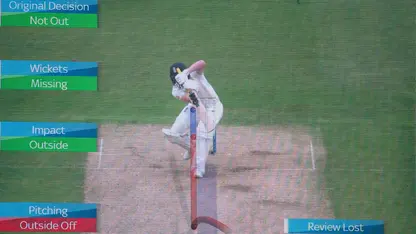

Hawk-Eye (Source: Getty Images)

Published - 21 Jul 2026, 10:11 AM• Read time - 2 mins
Cricket has changed drastically in the last three decades, and the introduction of Hawk‑Eye has been one of the most prominent factors that has contributed to this transformation.
Hawk‑Eye is essentially a technology that uses a computer vision set-up to predict the trajectory of the ball after it encounters an obstacle, usually the pads of a batter.
Who invented Hawk‑Eye?
Former Buckinghamshire cricketer Paul Hawkins was one of the co‑inventors of Hawk‑Eye. Hawkins was also a mathematician and an entrepreneur.
When was Hawk‑Eye introduced in cricket?
Hawk‑Eye was introduced in cricket for the first time in 2001. Since then, the technology has been used effectively to resolve one of cricket’s biggest puzzles: LBW.
How does Hawk‑Eye work?
Hawk‑Eye uses multiple high‑speed video cameras, placed at different parts of the ground, to follow the path of the ball as soon as it comes into play from the moment it is released from the bowler’s hand until it is deemed dead by the on‑field umpires.
The footage captured by the cameras is processed by a special computer designed specifically for this task. The computer then transforms the footage into a 3D image to predict the delivery's path to the stumps, even if it encounters an obstacle like a batter’s pads along the way.
How reliable is Hawk‑Eye?
It is understood that Hawk‑Eye technology is 99.99% accurate. Hawk-Eye is equipped to predict and track all kinds of bowling variations: seam, swing, spin, and bounce.
How has cricket changed since the introduction of Hawk‑Eye?
Hawk‑Eye has been nothing short of a game‑changer. In its early years, it revealed how often umpires got LBW decisions wrong and the consequences those decisions had for the outcome of games.
But the ICC did not have any mechanism in place to overturn those decisions despite the presence of Hawk‑Eye. However, the introduction of the DRS in July 2008, during India’s tour of Sri Lanka, turned out to be a watershed moment in the sport.
Teams were given the freedom to challenge the umpires’ decisions, and the third umpire used Hawk‑Eye technology to make the right call.
How many sports use Hawk‑Eye?
Other than cricket, Hawk-Eye is also used in tennis, football, rugby, baseball, basketball, ice hockey, American football (NFL), badminton, volleyball, Gaelic football, hurling, swimming, and Aussie Rules.