


What are inswingers and outswingers in cricket and how do they work?
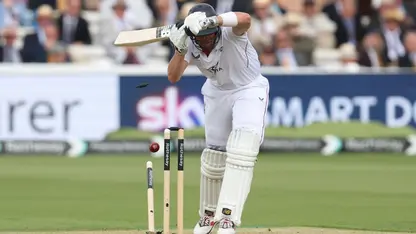

Jamie Smith loses his off-stump (Source: Getty Images)

Published - 09 Jul 2026, 07:47 PM• Read time - 2 mins
Swing bowling is one of the most potent weapons in a fast bowler’s arsenal. Think of it as an extra string to the bow, because pace alone rarely guarantees success at the international level. Modern batters are well prepared to handle sheer speed. With access to advanced bowling machines, they can train against deliveries exceeding 150 kmph, adjusting the pace to their liking. As a result, raw pace only unsettles them when it is truly hostile.
What continues to trouble batters most, however, is swing. The movement of the ball in the air adds an element of unpredictability that even the best struggle to master. Swing is broadly divided into two categories: conventional swing and reverse swing. Conventional swing itself has two sub‑types: outswing and inswing. Let’s break them down one by one.
Outswing
Outswing occurs when, say, a right‑arm pacer bowling to a right‑handed batter makes the ball move away in the air, continuing its outward path after pitching. To the batter, it feels like the ball is teasing the edge of the bat, luring him into a false stroke.
How to bowl an outswinger?
For a right‑arm pacer, the grip is crucial. Hold the ball seam‑up, with the seam angled towards first slip. At the point of release, flick the wrist so the seam position encourages the ball to drift away. If executed properly, it can produce the classic caught‑behind dismissal.
Inswing
Inswing is the opposite. Picture a left‑arm pacer bowling to a right‑hander: the ball curves in through the air and continues to jag back after pitching. To the batter, it feels like the ball is rushing into the body or the stumps, forcing hurried footwork.
How to bowl an inswinger?
The pacer locks the wrist with the seam pointing towards the leg slip. On release, the ball curves inward, threatening the pads and stumps. This delivery is tailor‑made for LBW or bowled dismissals, especially when combined with late swing.
Why does swing matter?
Swing bowling is not just about skill; it’s about psychology. Outswing tempts batters into playing at balls they should leave, while inswing forces them to defend deliveries that could trap them. Together, they create uncertainty, and uncertainty is a bowler’s greatest ally.