


What is a Knuckle Ball in cricket and how does it work?
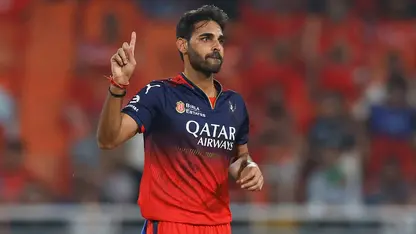

Bhuvneshwar Kumar (Source: Getty Images)

Published - 01 Jul 2026, 06:23 AM• Read time - 3 mins
In the 21st century, cricket has become heavily dominated by batters with the introduction of powerplays, free hits and field restrictions penalties, among several aspects affecting the balance of the game. To counter this, bowlers often have to come up with some new tricks up their sleeves to outfox the batters and deceive them into giving away their wickets.
One such trick adopted by the bowlers in modern-day cricket is a ‘knuckle ball’, which is similar to a slower delivery but with a slight variation. The idea behind bowling the knuckle ball is to trick batters into playing their shots too early and miss the delivery completely or mishit it.
The knuckle ball is usually delivered by resting it beneath the knuckles of the index and middle fingers rather than gripping it with the fingertips. From the batter's perspective, it looks like a conventional delivery, but it comes out much slower than expected, often causing them to mistime their shot.
The origin of knuckle ball
The knuckleball was inspired by baseball, where it is considered a mysterious pitch and called ‘unhittable’, due to its unpredictable movement. It is delivered in a manner that eliminates any kind of spin on the ball, but it sometimes moves in more than one direction before reaching the batter, leaving them absolutely dumbfounded.
The science behind the knuckle ball
As the ball travels through the air, a thin layer of air known as the boundary layer forms around its surface. This layer cannot remain attached to the ball throughout its surface and eventually separates from it. The point at which this separation occurs influences the air pressure on either side of the ball, as later separation creates lower pressure on that side.
When there is a difference in pressure between the two sides, the ball experiences a sideways force, causing it to swing. The seam of a cricket or baseball plays a crucial role by disturbing the boundary layer, altering the separation point and, in turn, generating swing.
As the ball travels through the air with very little spin, its rotating seam disrupts the boundary layer unevenly across the surface. This creates a side force that changes in both direction and intensity during the flight, making the ball wobble or "knuckle" unpredictably.
Another characteristic of the delivery is its sharper dip, as the ball tends to drop more abruptly than a conventional delivery, making it even harder for the batter to judge.
The pioneers of knuckle ball
Star India fast bowler Zaheer Khan is known as the pioneer of the knuckle ball in international cricket, as he put it on display during the 2011 World Cup. However, a lesser-known cricketer, Jeetan Sareen, is often credited for developing it. India’s Bhuvneshwar Kumar has also mastered the art in modern-day cricket. New Zealand's Trent Boult and Australia's Andrew Tye are among the few other players known to possess the delivery in their armoury.