


What is LBW in cricket and how does it work?
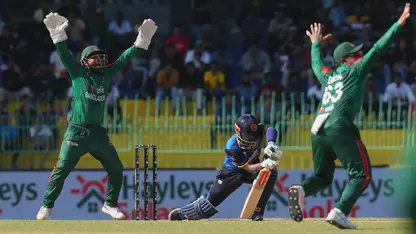

Bangladesh players appeal for lbw as Kusal Mendis is struck on his pads (Source: Getty Images)

Published - 07 Jul 2026, 07:53 PM• Read time - 4 mins
What is LBW?
LBW, or leg before wicket, is one of cricket’s most fascinating and often misunderstood dismissals. For casual fans, it can feel like a puzzle: it isn’t simply about the ball striking the batter’s pads, but about a combination of factors: where the ball pitched, where it struck, whether a shot was offered, and whether the ball would have gone on to hit the stumps. In short, LBW comes into play when a delivery destined for the wicket is intercepted by the batter’s body, usually the pads, but the decision is layered with nuance.
When did the lbw law first appear?
The lbw law dates back to 1774, introduced to stop batters from deliberately using their legs as a shield against the stumps. The original wording was blunt:
“The striker is out if he puts his leg before the wicket with a design to stop the ball and actually prevent the ball from hitting it.”
It was done to ensure cricket remained a contest of bat versus ball, not body versus ball.
How has the law evolved?
Over time, the law was refined to balance fairness. In 1839, the Marylebone Cricket Club (MCC) clarified that for LBW to apply, the ball had to pitch in line with the stumps. Batters could use their pads if the ball pitched outside off or leg stump.
A significant amendment came in 1980, when the MCC ruled that a batter could be given out even if struck outside off stump, provided the ball was heading for the stumps, and no shot was offered. This closed the loophole where batters could pad away deliveries without attempting to play them.
Factors umpires consider before giving a batter out LBW
- Ball pitching: The first question is where did the ball land? For lbw to be possible, the delivery must pitch either in line with the stumps or outside the off stump. If it pitches outside leg stump, the batter is automatically safe. This safeguard exists to prevent bowlers from unfairly targeting the leg side, where batters would have little chance to connect with the ball.
- Point of impact: Next comes where the ball struck the batter’s body. Usually, this means the pads, but technically it can be any part of the body other than the gloves. If the impact is in line with the stumps, LBW is possible. If it’s outside the line, the batter is safe unless no shot was offered. This distinction is crucial: a batter who pads up without attempting a stroke can still be given out, even if the ball hits them outside off stump.
- Trajectory of the ball: Umpires must then judge the ball’s path. Would it have gone on to hit the stumps if not intercepted? This is often the trickiest part, requiring sharp judgment and, in modern cricket, the aid of ball‑tracking technology (DRS). If there’s reasonable doubt, the benefit goes to the batter. But if the trajectory clearly shows the ball crashing into the wicket, LBW is on the table.
- Shot offered: Finally, intent matters. If the batter played a genuine shot and the ball struck them outside off stump, they survive. The law protects positive play. However, if no shot is offered, for example, the batter simply pads the ball away, then even an impact outside off stump can result in dismissal. This clause discourages negative tactics and ensures the contest remains between bat and ball.
How does the lbw law stand today?
The MCC's Law 36 gives a detailed description of the law related to the lbw dismissal.
36.1 Out LBW The striker is out LBW if all the circumstances set out in 36.1.1 to 36.1.5 apply:
36.1.1 The bowler delivers a ball, not being a no-ball.
36.1.2 The ball, if it is not intercepted full-pitch, pitches in line between wicket and wicket or on the off side of the striker’s wicket.
36.1.3 The ball not having previously touched his/her bat, the striker intercepts the ball, either full-pitch or after pitching, with any part of his/her person.
36.1.4 The point of impact, even if above the level of the bails, either is between wicket and wicket or, if the striker has made no genuine attempt to play the ball with the bat, is between wicket and wicket or outside the line of the off stump.
36.1.5 But for the interception, the ball would have hit the wicket.
36.2 Interception of the Ball 36.2.1 In assessing points in 36.1.3, 36.1.4 and 36.1.5, only the first interception is to be considered.
36.2.2 In assessing point 36.1.3, if the ball makes contact with the striker’s person and bat simultaneously, this shall be considered as the ball having first touched the bat.
36.2.3 In assessing point 36.1.5, it is to be assumed that the path of the ball before interception would have continued after interception, irrespective of whether the ball might have pitched subsequently or not.
36.3 Off Side of Wicket The off side of the striker’s wicket shall be determined by the striker’s batting position at the moment the ball comes into play for that delivery.