


What is Mankading in cricket and why is it so controversial?
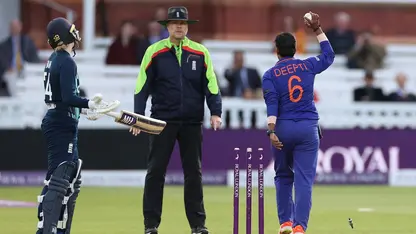

Deepti Sharma runs out Charlie Dean at the non-striker's end (Source: Getty Images)

Published - 04 Jul 2026, 05:17 PM• Read time - 3 mins
What does Mankading mean?
Mankading refers to the act of running out the batter at the non-striker’s end if they leave their crease before the ball is released. The bowler, in their delivery stride, can dislodge the bails to dismiss the batter. The term comes from legendary Indian allrounder Vinoo Mankad, who famously ran out Australia’s Bill Brown in the Sydney Test of 1947. Brown, opening the innings, backed up too far and Mankad removed the bails in his follow-through.
Why do bowlers use Mankading?
Bowlers use Mankading to stop the non-striker from stealing ground before the ball is bowled. If a batter backs up too far, it gives the batting side an unfair advantage. Just as bowlers are penalised for overstepping, Mankading ensures batters are penalised when they try to gain ground illegally.
What does the law say?
Law 38.3.1 - At any time from the moment the ball comes into play until the instant when the bowler would normally have been expected to release the ball, the non-striker is liable to be run out if he/she is out of his/her ground. In these circumstances the non-striker will be out run out if he/she is out of his/her ground when his/her wicket is put down by the bowler throwing the ball at the stumps or by the bowler’s hand holding the ball, whether or not the ball is subsequently delivered.
Law 38.3.1.1 - The instant when the bowler would normally have been expected to release the ball is defined as the moment the bowler’s arm reaches the highest point of his/her normal bowling action in the delivery swing.
Law 38.3.1.2 - Even if the non-striker had left his/her ground before the instant at which the bowler would normally have been expected to release the ball, once the bowler has reached that point it is no longer possible for the bowler to run out the non-striker under this Law.
Why is there stigma around Mankading?
Over time, non-strikers backing up too far has been normalised because bowlers rarely challenged it. As a result, whenever a bowler enforces the law, they are often criticised by fans and even former players. The bowler is painted as the villain, even though the batter is the one breaking the rules.
What has the MCC done to destigmatise Mankading?
The Marylebone Cricket Club (MCC), custodians of the laws of cricket, has repeatedly defended Mankading. In 2022, MCC Laws Manager Fraser Stewart told the Times:
“The bowler is always painted as the villain but it is a legitimate way to dismiss someone and it is the non-striker who is stealing the ground. It is legitimate, it is a run-out and therefore it should live in the run-out section of the laws.”
Which Mankading dismissals have caused the most controversy?
Two incidents stand out:
England vs Sri Lanka, 5th ODI, Edgbaston, June 3, 2014
Sri Lankan off-spinner Sachithra Senanayake ran out Jos Buttler for backing up too far in the 44th over. Buttler was clearly out of his crease when Senanayake broke the stumps. The on-field umpires, Chris Gaffaney and Michael Gough, consulted Sri Lanka captain Angelo Mathews to confirm if he wanted to uphold the appeal. Mathews said yes, and Buttler had to depart. The dismissal sparked a huge backlash on social media, with Senanayake heavily criticised despite acting within the law.
England vs India, ODI series decider, Lord’s, September 24, 2022
Indian allrounder Deepti Sharma ran out Charlie Dean at the non-striker’s end. England lost the match by 16 runs. Dean’s dismissal triggered a storm of criticism from English cricketers and fans online, even though Deepti’s action was completely legitimate under the laws.