


What is follow-on rule in Test cricket? Explained
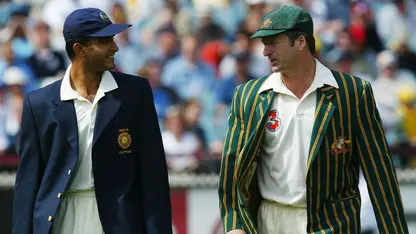

Sourav Ganguly and Steve Waugh (Source: Getty Images)

Published - 17 Jun 2026, 12:36 PM• Read time - 3 mins
The follow‑on is one of the oldest laws still preserved in the MCC rule book, and despite the passage of time, it remains a vital part of Test cricket. Far from being obsolete, it continues to shape the tactics and drama of the longest format.
In international cricket, the follow‑on applies only in Tests. It can be enforced exclusively by the team that batted first, giving them the option to ask the opposition to bat again immediately after being dismissed in their first innings.
When can a team enforce the follow‑on?
As outlined earlier, only the side batting first can enforce the follow‑on. If they finish their innings with a lead of 200 runs or more, they may choose to exercise this option. In that case, the team that batted second must return straightaway to begin their second innings.
Clause 14.1 of the MCC rule book states:
“In a two‑innings match of 5 days or more, the side which bats first and leads by at least 200 runs shall have the option of requiring the other side to follow their innings. The same option shall be available in two‑innings matches of shorter duration with the minimum leads as follows: – 150 runs in a match of 3 or 4 days; – 100 runs in a 2‑day match; – 75 runs in a 1‑day match.”
Clause 14.3 adds:
“If no play takes place on the first and second days of the match, clause 14.1 shall apply in accordance with the number of days remaining from the start of play. The day on which play first commences shall count as a whole day for this purpose, irrespective of the time at which play starts. Play will have taken place as soon as, after the call of Play, the first over has started.”
This means that if the opening day of a Test is completely washed out, leaving only four days of play, the follow‑on threshold drops to a lead of 150 runs.
Who decides to enforce the follow‑on?
The decision rests primarily with the captain of the team that batted first, though the coaching staff and leadership group often weigh in. According to Law 14.2 of the MCC rulebook:
“A captain shall notify the opposing captain and the umpires of his/her intention to take up this option. Once notified, the decision cannot be changed.”
Why do teams enforce the follow‑on?
The follow‑on is usually enforced to push for a result and reduce the chance of a draw. With a cushion of 200 runs or more, captains often back their bowlers to dismiss the opposition again without needing to bat a second time. Even if the opposition manages to erase the deficit, they rarely set a fourth‑innings target that is truly threatening.
Why do captains sometimes refrain from exploiting the follow‑on option?
There are two main reasons:
- To avoid overexhausting their bowlers.
- To avoid the challenge of batting last on a deteriorating pitch, where uneven bounce and low turn make run‑scoring far more difficult.
Famous instances of teams losing after enforcing the follow‑on
Though rare, there have been four occasions in Test history where a team enforcing the follow‑on ended up losing:
- Australia vs England, December 14, 1894 (SCG) Australia (586 & 166) lost by 10 runs to England (325 & 437). First‑innings lead: 261.
- England vs Australia, July 16, 1981 (Headingley) Australia (401/9 dec & 111) lost by 18 runs to England (174 & 356). First‑innings lead: 227.
- India vs Australia, March 11, 2001 (Eden Gardens) Australia (445 & 212) lost by 171 runs to India (171 & 657/7 dec). First‑innings lead: 274.
- New Zealand vs England, February 24, 2023 (Basin Reserve) England (435/8 dec & 256) lost by 1 run to New Zealand (209 & 483). First‑innings lead: 226.