


Allen - Seifert show stuns South Africa as New Zealand storm into final
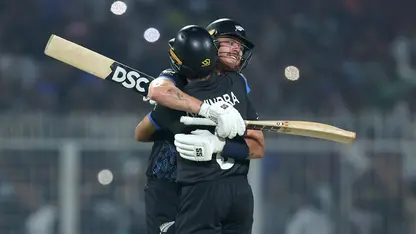

Finn Allen and Rachin Ravindra (Source: X/@ICC)

Published - 04 Mar 2026, 09:02 PM• Read time - 7 mins
Match Overview
New Zealand and South Africa locked horns in the first semi-final of the ICC T20 World Cup 2026, at the Eden Gardens in Kolkata on Wednesday, March 4. New Zealand captain Mitchell Santner won the toss and elected to bowl first.
Cole McConchie provided the Kiwis with a very good start as the off spinner sent back the dangerous left-handers Quinton de Kock and Ryan Rickelton off successive deliveries in the second over of the match itself. Skipper Aiden Markram and Dewald Brevis stabilised the innings and took calculative risks as New Zealand's fielding lapses also aided the Proteas' recovery.

South Africa ended the powerplay at 48/2 as the batters started to look comfortable in the middle. But, soon after Rachin Ravindra dismissed Markram much to his own relief perhaps as it was he who had dropped the Proteas skipper earlier in the innings. Miller joined Brevis and just when the stand started to look ominous for the Kiwis, Ravindra and Jimmy Neesham sent both of them back in the space of two deliveries to put South Africa in trouble at 77/5 in the 11th over.
The responsibility now rested with the new pair of Tristan Stubbs and Marco Jansen and the duo did not disappoint. Starting off cautiously, the batters began accelerating together soon after, picking the balls and spots correctly. The partnership brought South Africa back into the game and enabled them to advance towards a competitive score. Stubbs, however, was dismissed in the penultimate over as the 73-run stand off 48 balls came to an end. The Proteas ended up scoring 169/8 as Jansen top-scored with 55* off 30 balls.
The Kiwi openers - Tim Seifert and Finn Allen - were in a destructive mood at the outset. The batters eked out 37 runs from the first three overs as they looked extremely comfortable in the middle. The South African bowlers were unable to stem the flow of runs as the duo went up a gear or two subsequently to end the powerplay at a massive 84 for no loss.
With this start, the game looked almost gone from the South Africans' hands as the Kiwis needed 86 runs off 84 balls now. There was no relenting from the right-handers as Seifert completed his 16th T20I fifty in just the eighth over. The partnership crossed the 100-run mark in the same over as it became a matter of how early New Zealand would win the match rather than anything else.
But, the Proteas conjured up a wicket as Seifert was bowled by Kagiso Rabada in the 10th over, thus bringing an end to the 117-run opening partnership. Ravindra joined Allen and the former did not need to do anything else but give the strike back to Allen who was going all guns blazing. The right-hander's rapid innings brought a rapid end to the match as the 26-year-old reached his third T20I century off the last ball of the match. Notably, the hundred came off just 33 balls and is now the fastest century in T20 World Cup history.
New Zealand won by nine wickets with a remarkable 43 balls remaining to book their tickets to Ahmedabad for the final on Sunday against either India or England.
Top run-scorer of the match
|
Player |
Team |
Runs |
Balls |
Fours |
Sixes |
Strike Rate |
| Finn Allen |
NZ |
100* |
33 |
10 |
8 |
303.03 |
Top wicket-taker of the match
|
Player |
Team |
Overs |
Maidens |
Runs |
Wickets |
Economy |
| Rachin Ravindra |
NZ |
4 |
0 |
29 |
2 |
7.25 |
Player of the Match
Finn Allen
Allen played the innings of his lifetime given the context of the game. The right-hander was on a different plane altogether and struck the ball with precise timing and immense power to deflate the Proteas bowlers. The Auckland-born reached his first fifty runs in just 19 balls and the next fifty in 14. Remarkably, the 33-ball innings included just four dot balls as Allen rocketed his team into the final.
Turning Point
Without a doubt, the 117-run 55-ball opening stand between Seifert and Allen took the game away from the South Africans in a matter of few minutes. The target posed by the Men in Green was competitive to say the least and the pressure of chasing in a big game can lead to a wrong step which can spell disaster. As a result, the Kiwis needed to get off to a positive start, but in all honesty, they did more than that wiping out the Proteas challenge in a flash.What the captains said
Winning Team Captain, Mitchell Santner (NZ)
"It was nice. I think, yeah, we knew obviously how good South Africa are, and they’ve shown that throughout the tournament. So, you know, to put on a performance like that in a crunch game is obviously pretty pleasing. Yeah, I guess every time, you get shown up or you lose a game, you’re learning from it. I guess you learn when you win as well. So, we knew we weren’t, on or as good as we could have been during that game (in Ahmedabad), and they played, you know, unbelievably well, especially on a wicket like that. So, yeah, I guess today it was trying to keep them under pressure for a long time. We obviously threw a little bit more spin at the start, which we didn’t do at Ahmedabad. But yeah, I think, you know, if you can take wickets throughout, it’s obviously a challenge to keep going with the bat. Yeah, I mean, there was always a, there’s a plan for the first two overs."
"(Talking about the bowling tactics) and then it’s kind of free for all after that. You know, I think with, uh, obviously the right-handers coming out briefly, obviously, there’s a lot of spin. Um, so we, we thought maybe if the ball was spinning away a bit more, it might be a bit more of a challenge, but, you know, I think even when it’s up in the slot, he (Markram) kind of hits it and it stays hit. So, yeah, it was, it was trying to, I guess, chop and change because the wicket was pretty good."
Losing Team Captain, Aiden Markram (SA)
"I think you look at conditions early and they bowled really well up front. Ball didn't quite feel like coming on, some were just stopping on the wicket and some where hitting quite low on the bat and they made scoring really tough and through that pressure builds and you lose wickets unfortunately. So give credit to their bowling unit and obviously with the bat, someone plays an innings like that, don't think you will come out on the right side of the result many times as a fielding team."
