


Australia head coach Andrew McDonald urges ICC to allow larger squads for ODI World Cup 2027
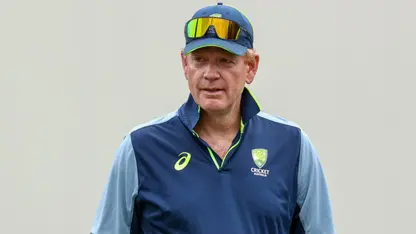

Andrew McDonald (Source: Getty Images)

Published - 29 Jul 2026, 04:27 PM• Read time - 3 mins
Australia men's cricket team head coach Andrew McDonald has called for bigger squad sizes at the upcoming edition of the ODI World Cup in southern Africa. McDonald believes that teams will rely heavily on their bench strengths, following the ICC's decision to restructure the format of the marquee tournament.
Notably, the ICC has announced that the tournament, set to be co-hosted by South Africa, Namibia and Zimbabwe, will be a 14-team event, unlike the previous two editions in 2019 and 2023, which saw 10 participants.
There will be a Super Series round, involving teams ranked 12, 13 and 14. The top team in the Super Series round will qualify for Round 2. Teams will be divided into two groups of six each in Round 2. The top three teams from each group and the next highest-placed team across both groups will then qualify for the Super Seven round. The Super Seven will be a round-robin stage, comprising 21 matches, where every team will play each other once. The top four teams at the end of the Super Seven round will qualify for the semifinals.
If a team that directly plays round 2 goes on to win the World Cup, then it'll have to play 13 matches. However, if one of the bottom three-ranked teams were to win the tournament, then it would end up playing 15 fixtures.
The tournament's longevity is bound to test the bench strength with the possibilities of injuries. Therefore, McDonald feels teams should be allowed 17-member squads instead of 15, which is the norm in an ICC event.
"One of the big things from my perspective is if it's going to be your pinnacle event, what do your squad sizes look like?" McDonald said while speaking to SEN radio in Australia. "We had the dilemma of what it looked like having a 15-player squad for the last World Cup, and I think New Zealand were in the same boat where we had a couple of injuries, Travis Head been the most notable one, and I think Kane Williamson and a couple of others for New Zealand, where you end up with sort of 12-13 players to select from early on in your tournament, and you're trying to carry those other players through the early rounds, and you're not able to play potentially the way that you want to play, or structure up the way that you think you need to, and in particular in countries where you in the north or the south or the east or the west, the conditions change quite significantly."
For the unversed, if a player, in an ICC event, gets injured at any point in time, then he cannot be left out midway and be replaced with another player, unless the ICC technical committee feels the injury cannot heal anytime soon.
"My push within it, any time you're playing more games in the same period of time, you don't want it to be attritional," McDonald said.
"You want the best players to be available. So, there should be a conversation around - yep, that's great, you've landed at that, okay, what about the squad sizes?
"This is going to be a pinnacle event. I think there's an argument to say, great, you've put more games in front of us, give us larger squads, allow us to play the way that we need to play within those conditions, and then also you've got the ability to carry those potential stars of the game that are under injury clouds leading in because the cricket leading into the World Cup is demanding, so you're going to have some people that potentially are 50-50 at that point in time.
"So let's carry the best players in there. Give us larger squads to be able to navigate through the early part, and then hopefully the pinnacle event has the best players playing, rather than being ruled out early on due to injury and the attritional nature of a World Cup."