


ICC makes changes to playing conditions to penalise batters involved in time wasting
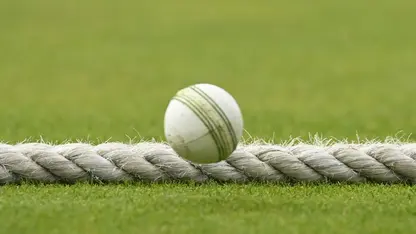

White Kookaburra crosses a boundary rope (Source: Getty Images)

Published - 02 Oct 2026, 12:34 AM• Read time - 3 mins
The International Cricket Council (ICC) has made several changes to its playing conditions, which will take effect from October 1 onwards across genders. The most notable is the decision to penalise batters who waste time while in the middle. If a batter is found wasting time, then the umpire at the bowler's end will issue a warning to him and also inform the non-striker, each incoming batter, the fielding captain and his fellow umpire.
The same cycle will be repeated on the second occasion. The umpire at the bowler's end shall award five penalty runs to the fielding team on the third and any subsequent occasion in an innings and inform the batting team, the square leg umpire and the fielding captain.
"If a batter is not ready to face the ball within the prescribed time, a warning will be issued for the first offence, a final warning for the second, and five penalty runs awarded to the fielding side for the third and each subsequent offence," read a press release from the ICC.
The "prescribed time" here refers to the time taken by the fielding side and the bowler to get ready for the next ball. Therefore, the striker needs to be ready to face the next ball as soon as the bowler is at the top of his mark. The only exception to this is at the time of a fall of a wicket. An incoming batter gets two minutes to make his way into the middle as soon as a wicket falls.
Meanwhile, the ICC has decided to introduce three different balls for men's, women's and junior cricket in terms of weight and size.
"The specifications for men’s cricket balls allow only a limited tolerance in size and weight. For women’s and junior cricket, manufacturers have often produced a single ball for both categories. New limits have now been introduced, establishing three distinct size and weight specifications for men’s, women’s and junior cricket," read the ICC release.
The international cricket governing body has also tried to get rid of the ambiguity around what constitutes an overthrow.
"This regulation has been clarified to remove ambiguity over what constitutes an overthrow. An overthrow is an attempt to direct the ball towards the stumps to prevent runs or effect a run-out. A misfield, whether an attempt to stop the ball or pass it to another fielder, does not constitute an overthrow."
The ICC has empowered the umpires to have a greater say in terms of determining when a ball is finally settled.
"The ball no longer must necessarily be in the bowler’s or wicketkeeper’s hands to be finally settled."
In its press release, the ICC has also clarified that a fielder/wicketkeeper must be in complete control of the ball for an umpire to consider a run out or stumping. "Merely touching the ball with the hand while it breaks the stumps does not establish holding it."
The ICC has also greenlit the use of pink balls in daytime Tests to reduce the loss of play due to poor light.
"The use of a pink ball must be agreed before the start of the Test and once agreed, must apply for the duration of the match. The decision cannot be changed after the match has started. Switching from red to pink ball is also not allowed once the match has commenced," read the release.
In an attempt to add more spice to Test cricket, the ICC has concluded that play will continue even if a wicket falls in the last over of the day (if that over has not been completed) and shall continue if the light and weather are satisfactory.
Among other changes, a T20I game will have a fixed 15-minute interval, and it can also be reduced to 10 minutes if time is lost. The head coach of a team "or their designate" can also enter the field during a drinks break.
The ICC has also added the leg-side wide trial permanently to the ODI and T20I playing conditions. It was a part of a huge blow-up recently when India met Japan in a one-off T20I game, named the Suzuki Cup, in Aichi-Nagoya.
The ODI and T20I PCs are now aligned to allow the ‘Head Coach or their designate’ to enter the field of play at drinks intervals.