


Abhishek Sharma: A captive of his own making
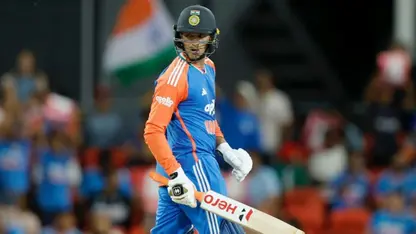

Abhishek Sharma (Source: IG/@abhisheksharma_4)

Published - 18 Feb 2026, 08:13 PM• Read time - 3 mins
Abhishek Sharma entered the 2026 T20 World Cup as the world’s No. 1 T20I batter, carrying an 891 rating and a strike rate of 192 that had redefined India’s approach at the top. He arrived with an aura, the expectation that he would dismantle attacks from the first ball. It compelled bowlers to devise plans, and fans to anticipate carnage as India counted on his explosiveness.
Yet three innings into the tournament, the narrative has flipped. Three ducks in three games, each one a product not of technical flaws, but of a mindset he has built and now feels compelled to honour. Abhishek has become a captive of his own making.

The anatomy of the dismissals
Each dismissal has followed the same internal script: the urge to validate his ultra‑aggressive identity, even when the ball or situation doesn’t demand it.
USA (February 7, Wankhede): Ali Khan went back of a length, outside off. Abhishek attempted the lofted back‑foot punch, a high‑risk shot meant to assert dominance early. USA had studied him, placed a sweeper cover exactly for that stroke, and he picked him out cleanly. It was a dismissal engineered by predictability.
Pakistan (February 15, Colombo): Salman Agha darted one in on a back‑of‑a‑length line at middle and leg. The ball skidded and climbed slightly. Abhishek, chasing the persona of the enforcer, tried to muscle it over the on‑side and offered a simple catch to Shaheen Afridi at mid‑on. The shot was dictated by identity, not by merit.
Netherlands (February 18, Ahmedabad): Two dot balls by Aryan Dutt triggered the same internal pressure. Dutt then bowled a back of a length ball on middle and off, skidding it in with the angle. Abhishek swung hard across the line, lost his leg stump, and trudged off, staring at the heavens.
A disruption in rhythm
Between the USA and Pakistan games, Abhishek missed the Namibia match due to a stomach bug, an unforeseen setback that threw him off rhythm and left him slightly astray. But even that doesn’t fully explain the pattern. His dismissals stem from mindset, not malaise.
The identity trap
Abhishek’s aggression is his power-hitting ability, but right now it has become his cage. He feels obligated to go big every ball, to live up to the caricature of the modern, ultra‑aggressive opener. In doing so, he has reduced his game to a binary: feast or famine. And famine has arrived three times in a row.
The way out
The solution is not to abandon aggression; it is to abandon the belief that aggression must begin from ball one. If Abhishek allows himself a handful of deliveries to assess conditions, trust his timing, and settle into the innings, his natural power‑hitting will more than compensate later. He doesn’t need to prove his intent every ball; his record already does that.
Why India needs him to break free
India’s title defence hinges on Abhishek rediscovering balance. When he fires, India’s entire template shifts. His presence at the top is not just tactical; it is transformational. But for that transformation to return, he must step out of the mould he has cast for himself.
Abhishek doesn’t need to change who he is. He simply needs to stop being a captive of his own making.
