


Solving India’s Samson‑Abhishek‑Sooryavanshi problem with one coherent plan
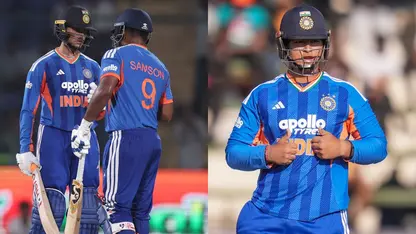

Sanju Samson, Abhishek Sharma and Vaibhav Sooryavanshi (Source: BCCI)

Published - 15 Sep 2026, 10:30 PM• Read time - 3 mins
Champion teams often share familiar traits: an unrelenting hunger for success, unwavering belief, players with rare skill sets and the problem of plenty. While these ingredients fuel dominance, the problem of plenty can just as easily become a fault line if not managed with clarity and conviction.
India’s T20I side is grappling with that very issue, and the most persistent complication lies at the top of the batting order. The Men in Blue are attempting to accommodate three openers when only two can walk out at a time.
The dilemma first surfaced before the ICC Men's T20 World Cup, when Ishan Kishan forced his way back into the squad on the back of a prolific Syed Mushtaq Ali Trophy. Sanju Samson and Abhishek Sharma were locked in as the preferred opening pair, but Samson’s lean run and Ishan’s irresistible consistency compelled the management to make a difficult call in their bid to defend the title. Samson was left out, allowing Ishan and Abhishek to take charge.
A family emergency for Rinku Singh reopened the door for Samson, and he responded with emphatic authority. His run-scoring spree powered India to another T20 World Cup triumph on March 8 at the Narendra Modi Stadium, earning him the Player of the Tournament award.
India did not play a T20I for more than three months, but the selection conundrum resurfaced during the two-match series in Ireland. Vaibhav Sooryavanshi, riding the momentum of a sensational IPL season, forced his way into the squad. India lost the series 2-0, with Samson managing scores of 5 and 0. He began the England series with a seven-ball 1, prompting the management to hand the 15-year-old a run of games.
Sooryavanshi, however, could not make full use of the three consecutive opportunities he received and was left out of the fifth T20I. Samson returned but managed only 27. In trying to give both players a run at each other's expense, the management inadvertently dented their confidence. Samson was then omitted from the Zimbabwe T20Is, where Sooryavanshi enjoyed a breakout series and claimed the Player of the Series award.
With India now facing Afghanistan at home, the management has backed the Samson-Abhishek pairing for the first two matches. With the series already sealed 2-0, India will be tempted to give Sooryavanshi another opportunity, and they should, but not at Samson’s expense.
The smarter approach is to rotate Abhishek and Samson, ensuring Sooryavanshi receives an uninterrupted run. The teenager has already shown he belongs at the international level, and his numbers reinforce that belief. But he needs exposure to varied conditions before India consider him for the 2028 T20 World Cup in Australia.
The pitches there offer pace and bounce, and Sooryavanshi has been tested by the short ball often enough to warrant deliberate preparation.
Samson and Abhishek, meanwhile, have logged substantial cricket across conditions worldwide. Rotating them allows India to keep an experienced head at the other end for Sooryavanshi while preserving the right-left combination that has served them well.
There may be the occasional defeat and inevitable external noise, but the management must hold firm. All three players have the potential to serve India for years, and clarity, not the lack of it, is what will unlock their collective value.