


Harsh‑hit by trolls, injury robs Rana of his chance to challenge the narrative at T20 World Cup
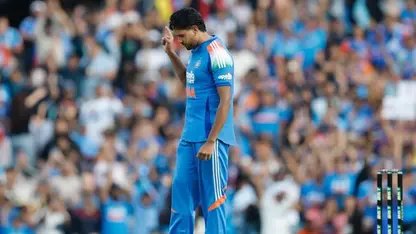

Harshit Rana (Source: Harshit_Rana_06 on IG)

Published - 07 Feb 2026, 11:28 AM• Read time - 3 mins
For a cricketer who has become social media’s favourite punchline, Harshit Rana was finally walking into a phase where the only thing that should have mattered was his cricket. But just when he had the biggest stage to push back against it, fate took that chance away.
Rana has, for a while now, been less a player and more a talking point. Every selection involving his name seems to arrive with an asterisk. The dominant perception around him is not of a young fast bowler trying to establish himself, but of a team management favourite who keeps getting picked.

The backlash that never let up
It was amplified brutally when former India captain Krish Srikkanth launched a scathing criticism of Rana on his YouTube channel. Questioning his selection for the ODI tour of Australia last October, Srikkanth remarked that there seemed to be “only one permanent member” in the squad, Harshit Rana, and added that “nobody knows why he is there in the team.”
He went further, suggesting that some players are ignored regardless of how well they do, while others are taken “even if they don’t,” and then delivered the line that stuck: the “best is to be like Harshit Rana and be a constant yes-man to Gambhir to be selected.” In the same breath, he linked Rana’s presence, along with that of Nitish Kumar Reddy, to India, effectively waving “goodbye to the trophy” instead of building properly towards the 2027 World Cup.
Such vitriol can wear anyone down, let alone a young quick trying to find his feet in international cricket.
The numbers that cut through the noise
Rana’s response in Australia, though, was solid. He finished as India’s leading wicket-taker in the three-match ODI series with six wickets at an average of 20.83 and an economy rate of 6.04. It didn’t end the debate, but it should at least have complicated the lazy narrative that he was there only because of a coach’s fondness.
If that series hinted at his bowling credentials, Indore last month underlined his batting ability. In the ODI series decider against New Zealand, India were 178 for 6 in 32.1 overs, the game drifting towards the inevitable. Rana walked in with the match almost dead and buried and produced 52 off 43 balls, with four fours and four sixes at a strike rate of 120.93.
More importantly, he added 99 runs with Virat Kohli, bringing India extremely close to the finish line. It was the kind of innings that summarised his ability to contribute under pressure.
Notably, when his name appeared in India’s squad for the T20 World Cup 2026, the focus was not on what he had done in Australia, but on his T20I numbers: nine wickets in nine games at an economy of 10.60. On paper, that economy rate is an easy stick to beat him with. The selection was again framed as unjustified.
The opportunity that slipped away
The T20 World Cup, in many ways, was the perfect stage for him. A global tournament, a high-pressure environment, a chance to bowl at the best, and show that he belonged. For a player whose career has been framed by perception, this World Cup offered the one thing he hadn’t yet had: time and visibility at the highest level to let performance speak louder than opinion.
Instead, the story turned cruel. In the warm-up game against South Africa in Navi Mumbai on February 4, Rana injured his right knee. The setback ended his tournament before it began, with Mohammed Siraj replacing him in the squad. Just like that, the one platform that could have allowed him to challenge the narrative around him disappeared.
That is the harshest part of this arc. When a player is trolled and abused, the only real rebuttal available to him is performance. Rana had already shown in Australia that he could deliver with the ball.
He had shown in Indore that he could contribute with the bat when the situation was dire. The T20 World Cup was supposed to be the next chapter in that quiet counter-argument: a chance to build a body of work that would make the easy labels harder to throw around.
Instead, the labels remain, the perception remains, and the player is left on the outside, watching a conversation about him that he cannot influence.
