


India must rediscover their aggressive identity to revive their T20 World Cup campaign
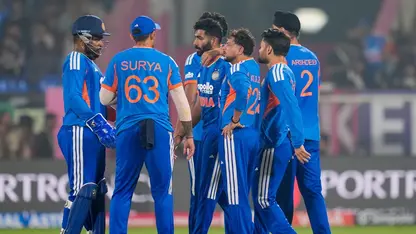

Team India (Source: BCCI)

Published - 24 Feb 2026, 10:32 PM• Read time - 4 mins
For a team that has spent the last few years redefining the limits of T20 batting, India’s approach in the ongoing World Cup has been a striking departure from their own blueprint. The side that once prided itself on an ultra‑aggressive, front‑foot mindset has instead adopted a far more tempered, almost hesitant rhythm, a shift that stands in sharp contrast to the expectations built in the lead‑up to the tournament.
Those expectations were not unfounded. In the five‑match T20I series against New Zealand just before the World Cup, India produced numbers that bordered on the outrageous. They blasted 238 batting first in Nagpur, chased 209 in just 15.2 overs to take a 2-0 lead, and then hunted down 154 in only 10 overs in the third T20I.

The crescendo came in the fifth match, where they posted 271, a total that reignited global conversations about whether a team could breach the 300‑run mark in T20 internationals. Many believed India were the likeliest to do it.
A turnaround no one anticipated
That is what makes the current shift so stark. The aggressive identity that once defined India’s T20 cricket has not travelled with them into the World Cup. The signs have been visible across matches. Tilak Varma, one of the key faces of India’s new‑age batting, has not mirrored the ultra‑aggressive template that shaped his rise. His scores: 25 off 16 against the USA, 25 off 21 against Namibia, 25 off 24 against Pakistan, and 31 off 27 against the Netherlands, have been steady but subdued, lacking the tempo that once made him central to India’s high‑octane approach.
The contrast sharpened further in India’s first Super Eight clash against South Africa. Chasing 188, India played more than 50 dot balls, an uncharacteristic statistic for a side that once prided itself on relentless pressure. Their innings peaked at a run rate of 6.31, reaching 101 for eight in 16 overs, never once threatening the required tempo. The chase did not collapse dramatically; it simply never ignited. In a match that demanded urgency from the outset, India’s innings moved in slow motion.
The broader implications of that defeat are significant. The 76‑run loss has dragged India’s net run rate down to –3.800, placing them in a must‑win scenario for the remainder of the Super Eight stage. They now need victories against Zimbabwe in Chennai on February 26 and against the West Indies on March 1 in Kolkata.
A recalibration India can’t delay: mindset, tempo and NRR now define their survival
But their fate is not entirely in their own hands. Before they take the field again, India will hope for a South Africa win over the West Indies, a result that would keep the Windies on two points. If the West Indies beat South Africa, the group could see a three‑way tie, with South Africa, West Indies, and India all potentially finishing on four points. In that scenario, the semifinal race would come down to net run rate, a metric where India currently trail significantly.
That is why the situation demands more than just wins; it demands a recalibration of attitude. India must rediscover the ultra‑aggressive approach that defined their pre‑World Cup form. The pitches in this tournament have not been as flat as those at home, but the conditions cannot dictate the mindset.
With their title defence on the line, India need to return to the template that once made them the most feared batting unit in the world, unrelenting, proactive, and willing to take the game forward from ball one. Their path to the semifinals is narrow, but the formula for staying alive is familiar: embrace the aggression that once set them apart.
India's qualification scenario if West Indies beat South Africa and South Africa beat Zimbabwe
vs South Africa: India lost by 76 runs | NRR -3.80
vs Zimbabwe: If India bat first, win by 100 runs
Beat India by 76 runs
Lose to West Indies by 25 runs
Beat Zimbabwe by just 25 runs, then their final NRR will be +1.27
West Indies
Beat Zimbabwe by 107 runs
Should not beat South Africa by more than 25 runs
Should lose to India by 60 runs or more
West Indies finish with a NRR of +1.20
