


India or Pakistan: Who survives the trial by spin in Colombo?
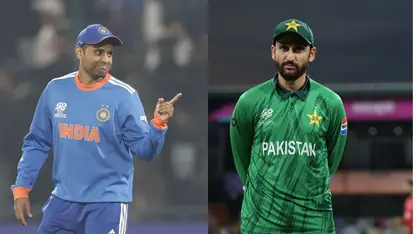

Suryakumar Yadav and Salman Ali Agha (Source: BCCI and PCB)

Published - 15 Feb 2026, 02:03 AM• Read time - 12 mins
R. Premadasa has long been a venue where spin plays an influential role. The surface is slow, highly favourable for spin, making it a genuine threat. Bounce is variable, and batters are forced to generate their own power against deliveries that hold in the surface.
On such a surface, the contest becomes a technical and tactical examination: who reads length quicker and who can keep the scoreboard moving without taking reckless risks. India and Pakistan both enter the T20 World Cup clash with high‑quality spin attacks, but their batters’ recent numbers against spin tell different stories.

India’s Batters: Built to take spin on
India’s batting group has produced a remarkably strong body of work against spin in T20Is since June 30, 2024. Abhishek Sharma (average of 33.91 and strike rate of 210.88), Ishan Kishan (average of 35.00 and strike rate of 244.18), and Shivam Dube (average of 28.20 and strike rate of 185.53) bring explosive intent and the ability to hit with the turn and against it.
India Batters vs Spin (30 June 2024 – 14 Feb 2026)
| Batter | Runs | Balls | Avg | SR |
|---|---|---|---|---|
| Abhishek Sharma | 407 | 193 | 33.91 | 210.88 |
| Ishan Kishan | 105 | 43 | 35.00 | 244.18 |
| Suryakumar Yadav | 311 | 202 | 62.20 | 153.96 |
| Tilak Varma | 332 | 245 | 55.33 | 135.51 |
| Hardik Pandya | 205 | 143 | 41.00 | 143.36 |
| Shivam Dube | 141 | 76 | 28.20 | 185.53 |
| Axar Patel | 78 | 68 | 15.60 | 114.71 |
Behind them, Suryakumar Yadav (average of 62.20 and strike rate of 153.96), Tilak Varma (average of 55.33 and strike rate of 135.51), and Hardik Pandya (average of 41.00 and strike rate of 143.36) offer stability with controlled aggression, players who can rotate at will and pick their moments to accelerate. Even Axar Patel, despite modest numbers (average 15.60 and strike rate of 114.71), is a left‑hander who can disrupt match‑ups.
This combination of high strike rates and high averages is rare in T20 cricket. It means India go after spinners, but will they be able to succeed with the same approach in Colombo remains to be seen.
Pakistan’s Batters: A more cautious profile
Pakistan’s numbers paint a contrasting picture. Only Sahibzada Farhan (average of 34.77, strike rate of 133.73), Shadab Khan (average of 126.00, strike rate of 168.00), and Mohammad Nawaz (average of 49.00, strike rate of 106.52) have produced impressive returns against spin in this period. The rest of the lineup has struggled with either fluency or consistency.
Pakistan Batters vs Spin (30 June 2024 – 14 Feb 2026)
| Batter | Runs | Balls | Avg | SR |
|---|---|---|---|---|
| Babar Azam | 204 | 195 | 29.14 | 104.62 |
| Agha Salman | 454 | 360 | 28.38 | 126.11 |
| Sahibzada Farhan | 452 | 338 | 34.77 | 133.73 |
| Fakhar Zaman | 271 | 232 | 20.85 | 116.81 |
| Usman Khan | 157 | 132 | 22.43 | 118.94 |
| Mohammad Nawaz | 147 | 138 | 49.00 | 106.52 |
| Faheem Ashraf | 101 | 83 | 14.43 | 121.69 |
| Shadab Khan | 126 | 75 | 126.00 | 168.00 |
Babar Azam’s strike rate of 104.62 against spin is a concern on a surface where dot‑ball pressure compounds quickly. Agha Salman (SR 126.11) and Usman Khan (SR 118.94) have been steady but not threatening.
Fakhar Zaman’s low average (strike rate of 116.81 and average of 20.85) and Faheem Ashraf’s limited returns (average of 14.43 and strike rate of 121.69) underline a middle order that has not found a reliable method against quality spin.
On a pitch where the ball grips and scoring options narrow, Pakistan’s reliance on a handful of performers becomes a structural vulnerability.
India’s Spin Attack: Depth and control
India’s spinners have been exceptional in T20Is over the same period. Varun Chakaravarthy (61 wickets at an economy of 7.30), Kuldeep Yadav (25 wickets at 7.73), Axar Patel (32 wickets at 7.20), and Washington Sundar (17 wickets at 5.79) form a unit with variety, control, and wicket‑taking threat.
India Spinners in T20Is (30 June 2024 – 14 Feb 2026)
| Bowler | Wkts | Runs | Overs | Avg | Econ | Best |
|---|---|---|---|---|---|---|
| Axar Patel | 32 | 558 | 77.3 | 17.43 | 7.20 | 3/33 |
| Kuldeep Yadav | 25 | 321 | 41.3 | 12.84 | 7.73 | 4/7 |
| Varun Chakaravarthy | 61 | 825 | 113.0 | 13.52 | 7.30 | 5/17 |
| Washington Sundar | 17 | 193 | 33.2 | 11.35 | 5.79 | 3/3 |
They can attack with wrist‑spin, squeeze with finger‑spin, and exploit match‑ups with precision. On a surface like Premadasa, this depth becomes a decisive advantage.
Pakistan’s Spin Attack: Dangerous but volatile
Pakistan’s spin attack is potent but less consistent. Mohammad Nawaz (47 wickets at an economy of 6.73), Saim Ayub’s part‑time role (26 wickets at 7.09), and Abrar Ahmed (47 wickets at 6.61) are genuine threats on slow turners.
Pakistan Spinners in T20Is (30 June 2024 – 14 Feb 2026)
| Bowler | Wkts | Runs | Overs | Avg | Econ | Best |
|---|---|---|---|---|---|---|
| Saim Ayub | 26 | 546 | 77.0 | 21.00 | 7.09 | 3/35 |
| Shadab Khan | 13 | 369 | 46.0 | 28.38 | 8.02 | 3/26 |
| Mohammad Nawaz | 47 | 651 | 96.4 | 13.85 | 6.73 | 5/18 |
| Abrar Ahmed | 47 | 796 | 120.2 | 16.93 | 6.61 | 4/9 |
| Usman Tariq | 11 | 87 | 14.4 | 7.90 | 5.93 | 4/18 |
But Shadab Khan’s dip (13 wickets at 8.02) and Usman Tariq’s early numbers (11 wickets at 5.93) mean Pakistan rely heavily on others to carry the load.
Both teams bring quality spin, but the decisive difference lies in how their batters handle it. On a surface where survival alone is rarely enough, India’s superior range, intent, and depth against spin give them the stronger profile to withstand and potentially win the trial by spin in Colombo.
