


India vs New Zealand: Abhishek Sharma masters the fuse to bury his T20 World Cup blues
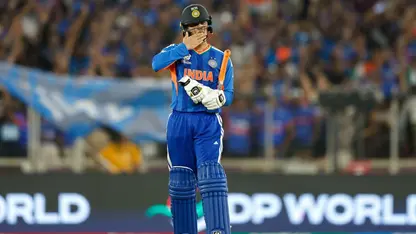

Abhishek Sharma (Source: BCCI)

Published - 08 Mar 2026, 06:08 PM• Read time - 3 mins
There was a time, not very long before the toss in the final of the ICC Men's T20 World Cup at the Narendra Modi Stadium in Ahmedabad, when Abhishek Sharma’s name on India’s playing XI sheet felt more like a debate than a decision.
- Seven innings
- Eighty-nine runs
- An average of 12.71
- A strike rate of 130.88
- One solitary half-century, and that too against Zimbabwe
For a player picked to be India’s tone‑setter, those numbers were as underwhelming as they could get. His place in the XI ahead of the final against New Zealand was a talking point, not a given.

Worse, there was a clear pattern to his dismissals. Abhishek had developed a very specific problem: right‑arm off‑spin. Salman Agha against Pakistan, Aryan Dutt against the Netherlands, Will Jacks in the semifinal against England, different bowlers, same story.
It wasn’t a technical flaw; it appeared more like a character trap.
For the last 12 months, Abhishek had built a reputation, almost a persona, as the henchman at the top, the hitter whose job was simple: take every bowler down, from ball one, no questions asked. In this World Cup, he kept trying to live up to that image. He kept swinging at the idea of himself and kept getting out.
But just when it looked like his campaign was destined to end as a nightmare, Abhishek mastered the fuse and buried his T20 World Cup blues.
He did it not with a defensive knock, not by abandoning who he is, but by finally choosing when to light the fire.
The first sign of that shift came on the second delivery of the second over. The matchup? Inevitable. Glenn Phillips, right‑arm off‑spin, round the wicket, wasting no time in attacking the angle that had haunted him all tournament.
This time, Abhishek didn’t swing at the narrative. He played the ball to its merit.
First delivery: a careful drive to cover. No flourish, no ego.
Second: a solid front‑foot block. Third: a punch to long‑on for a single, finally off the mark.
No panic, no premeditation. Just cricket shots, played on merit. The fuse was still there; he simply decided not to light it blindly.
The shift wasn’t permanent caution; it was more of a calculated delay.
He found his first boundary in the third over, against Jacob Duffy. Duffy pitched it up, and Abhishek responded with intent, a heave straight down the ground for four. The next ball was in his arc and went over mid‑off as he launched a lofted drive. Two boundaries, both to balls that deserved punishment, not to prove a point.
From there, the version of Abhishek India had picked for this World Cup finally arrived.
The restraint against Phillips gave way to the familiar, ferocious tempo, but now it was built on judgment, not impulse. He didn’t look back. The shots flowed, and the numbers began to tell a very different story.
He brought up his half‑century off just 18 balls, the fastest fifty in a men’s T20 World Cup knockout, edging Finn Allen and Jacob Bethell by a delivery. Six fours, three sixes, a strike rate of 247.61. A statement that aggression, when filtered, can be even more devastating.
Alongside Sanju Samson, Abhishek powered India to 92 in the powerplay, the joint‑highest powerplay score in a men’s T20 World Cup, equalling West Indies’ 92/1 against Afghanistan in 2024. For a player whose very presence in the XI had been questioned, he didn’t just justify his selection; he defined the start of the final.
His dismissal, nicking a wide ball from Rachin Ravindra on 52, felt almost incidental by then. The job was done. The damage was inflicted. The version of Abhishek Sharma India needed had finally turned up on the night that mattered most.
Abhishek didn’t abandon his character. He stopped being trapped by it.
He faced his old nemesis, the right‑arm off‑spinner, round the wicket, and chose discretion over theatre. He kept the fire, but mastered the fuse.
And in doing so, on a night when his World Cup could have been remembered for all the wrong reasons, Abhishek Sharma buried his blues and wrote the innings that might just define the next chapter of his career.
