


India’s T20 World Cup final hope hinges on a risky five-bowler blueprint
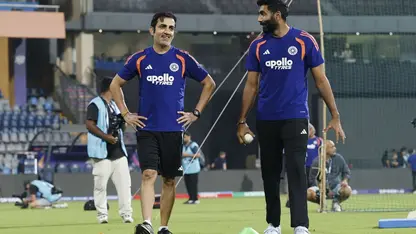

Gautam Gambhir and Jasprit Bumrah (Source: BCCI)

Published - 07 Mar 2026, 10:45 PM• Read time - 2 mins
India enter the ICC Men’s T20 World Cup final against New Zealand as a dominant, well‑oiled unit. Yet beneath the momentum lies a structural concern that could shape not just the final, but India’s T20I future: their rigid dependence on five frontline bowlers to deliver all 20 overs.
Hardik Pandya, Jasprit Bumrah, Axar Patel, Varun Chakravarthy, and Arshdeep Singh form a fixed bowling group. When they operate collectively, India look untouchable. But T20 cricket rarely offers uniformity, and the semifinal against England showed how vulnerable India look when multiple bowlers lose control.

Chasing 254, England dismantled every Indian bowler except Bumrah. Arshdeep conceded 51 at 12.80 per over, Hardik 38 at 9.50, Varun 64 at 16 (the most expensive spell recorded in a T20 World Cup match by an Indian), and Axar 35 at 11.70. Bumrah alone held the innings together, giving away just 33 at 8.33 and removing Harry Brook with the first ball of his spell.
With no reliable sixth bowler, Suryakumar Yadav had no choice but to let Varun complete his four overs despite the spinner struggling for rhythm and being taken to the cleaners repeatedly by Jacob Bethell. The lack of trust in Shivam Dube’s bowling was clear, as Suryakumar did not introduce him earlier, even as Varun leaked runs every over.
Dube was finally brought on only for the last over, with England needing 30, and still conceded 22, after getting hit for three sixes by Jofra Archer.
Dube’s recent numbers explain the hesitation. After returning 1/11 in 2.2 overs against Namibia, he has since conceded 35 against Netherlands, 32 against South Africa, 46 against Zimbabwe, did not bowl against West Indies, and leaked 22 in his solitary over against England. India clearly do not see him as a dependable sixth option.
But avoiding him is not a long‑term solution. India must throw Dube at the deep end in bilaterals at least to make him battle‑hardened so that he can be relied upon in crunch situations, especially in ICC events, as one does not become an expert sailor by avoiding rough seas.
The semifinal served as a warning: not all five frontline bowlers will deliver every night. Four of them had an off day, and India survived only because Bumrah produced a spell of rare control. Had he gone for runs, India’s campaign would likely have ended there.
As India step into the final and look beyond it, the question is no longer about their strength but about the sustainability of a five‑bowler template that leaves no margin for error on nights when more than one bowler falters.
