


IPL 2026 | Kolkata Knight Riders Preview: Rana, Pathirana and the tight corners KKR navigate
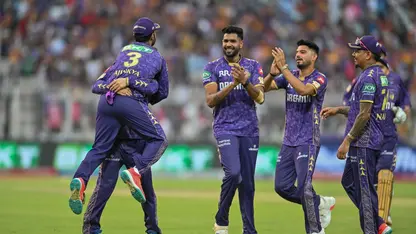

Kolkata Knight Riders (Source: Getty Images)

Published - 17 Mar 2026, 09:32 PM• Read time - 4 mins
After the high of their IPL 2024 title under Shreyas Iyer, Kolkata Knight Riders crashed back to earth in 2025. An eighth-place finish, with just five wins, seven losses, and two no-results, underlined a season where there was hardly any momentum.
The franchise has chosen continuity in leadership, retaining Ajinkya Rahane as captain, and their campaign begins with a demanding assignment against Mumbai Indians at the Wankhede on March 29.

Strengths
Lower-order muscle
Even without Andre Russell, KKR retain genuine power in the lower middle order. Rinku Singh remains the designated finisher, and his IPL strike rate of 145.17 reflects both intent and reliability at the death. He is complemented by Rovman Powell, a seasoned T20 campaigner and former West Indies captain, who has an IPL strike rate of 146.58.
Together, they give KKR the ability to accelerate sharply at the fag end.
Ramandeep Singh, with 31 IPL games already behind him and a strike rate of 158.39, adds another layer of hitting depth. In a tournament where finishing power often separates mid-table sides from playoff contenders, KKR’s late-overs muscle is a genuine strength.
A fast bowler with a point to prove
Umran Malik offers KKR something few teams possess: sustained high pace. His 22-wicket season in IPL 2022 propelled him into the India setup, where he featured in eight T20Is and 10 ODIs before slipping out of contention.
The motivation is obvious; another standout IPL could push him back into national selection conversations.
Umran can consistently operate above 150 kph and once clocked 156.7 kph in the cash-rich league. Bowlers in that bracket are rare and carry premium value. Importantly, he has worked on his change of pace and variations, an area that previously limited his effectiveness. If those improvements hold under pressure, KKR’s attack gains a cutting edge it otherwise lacks.
Weaknesses
A bowling attack that looks thin
The absence of Harshit Rana and Matheesha Pathirana, even partially, leaves KKR’s bowling exposed. At Eden Gardens, where the dimensions are small, a robust attack is non-negotiable. Without those two, the seam unit lacks depth, and the margin for error shrinks considerably. This fragility places extra strain on the remaining frontline options.
Varun Chakravarthy’s form and confidence
On paper, Varun Chakravarthy arrives with numbers that suggest success: he finished the T20 World Cup as joint-highest wicket-taker with 14 wickets, alongside Jasprit Bumrah. But the story behind the figures is more complicated. He conceded runs at 9.25 per over, a stark contrast to his T20I career economy of 7.55, and the performances hinted at a bowler short on confidence and control.
For KKR, that is a concern. In the absence of Harshit and Pathirana, they need Varun to operate closer to his best, in tandem with Sunil Narine. If Varun’s struggles persist, KKR risk fielding a spin unit that leaks runs instead of dictating terms.
Opportunities
This season presents a significant leadership test for Ajinkya Rahane. He inherits a squad with clear gaps: Varun’s form, the absence of Rana and Pathirana, and a bowling group under scrutiny. That context also creates an opening for Rahane to assert his captaincy credentials through clarity in roles and tactical sharpness in close games.
There is also a parallel storyline in the coaching setup. Abhishek Nayar, who was associated with KKR as an assistant, steps up as head coach after serving under Chandrakant Pandit in 2025. His recent trajectory has been turbulent: he was sacked as India’s assistant coach by the BCCI in April 2025, with his contract terminated before completing a year, and he oversaw a wooden-spoon finish with UP Warriorz in WPL 2026.
For Nayar, a strong IPL 2026 with KKR is more than a professional milestone; it is a chance to restore his reputation.
Threats
Top-order logjam and selection headaches
KKR’s biggest threat may come from within: a problem of plenty in the top order. They have Tim Seifert and Finn Allen, both coming off outstanding T20 World Cup campaigns. Seifert was the second-highest run-scorer at the tournament with 326 runs in nine games at an average of 46.57 and a strike rate of 166.32, including four fifties.
Allen was even more explosive, scoring 298 runs in nine games at 49.66 and a strike rate of 200. He recorded the fastest-ever T20 World Cup hundred in the semifinal against South Africa at Eden Gardens, KKR’s home ground.
If KKR choose to open with the two Kiwis, Sunil Narine is likely to move down the order. That is not a trivial adjustment. Narine has a strike rate of 166.51 in the IPL and has repeatedly given KKR rapid starts as an opener. Removing him from that role creates a tactical headache and risks blunting one of their most disruptive weapons.
The number three conundrum
The acquisition of Cameron Green adds another layer of complexity. KKR broke the bank to sign him at the IPL 2026 auction for 25.20 crore, and his IPL hundred for Mumbai Indians in 2023, while batting at three against SRH at Wankhede, suggests that No. 3 is his optimal slot. Logically, KKR will want to maximise their investment by using him there.
But that pushes Ajinkya Rahane and Angkrish Raghuvanshi down to four and five, away from their preferred top-three positions. Rahane’s best work has historically come at the top of the order, and Raghuvanshi is viewed as a developing top-order batter.
If they are forced to adapt to roles that don’t suit their games, KKR risk underutilising key players.
The danger is clear: if KKR do not settle their batting order early, they could spend a large part of the season tinkering, burning energy on combinations instead of execution, and that may play in favour of the opposition.
