


IPL 2026: Sunrisers Hyderabad and the challenge of holding what they score
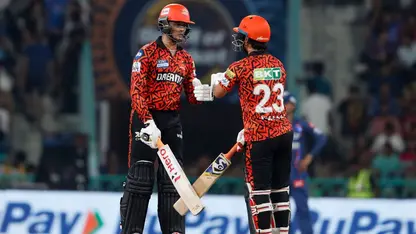

Abhishek Sharma and Ishan Kishan (Source: Getty Images)

Published - 21 Mar 2026, 10:45 PM• Read time - 3 mins
If there is one team that has consistently threatened to breach the 300‑run mark, it is Sunrisers Hyderabad. They hold the highest team total in IPL history (287), and remarkably, the four highest totals ever recorded in the league all belong to them. Few sides have pushed the boundaries of T20 batting quite like SRH.
Yet their go big or go home approach did not translate into sustained success last season. They finished sixth, collecting only 13 points at the end of the league stage. The batting fireworks were undeniable, but the lack of balance proved costly. As they enter the new season, SRH remain one of the most explosive sides in the competition, but also one of the most volatile.

Strengths
Batting muscle like no other
SRH arguably possess the most intimidating batting line‑up in the tournament. Travis Head has amassed 1146 IPL runs at a strike rate of 170.02, and alongside Abhishek Sharma, who strikes at 163.01, forms an opening pair capable of dismantling any attack.
Ishan Kishan at No. 3 only deepens the threat. He finished as the fourth‑highest run‑getter at the ICC Men’s T20 World Cup 2026 with 317 runs at a staggering strike rate of 193.29. Heinrich Klaasen remains the heartbeat of their middle order, having accumulated 1480 IPL runs at 169.72.
Nitish Reddy (132.87) and Liam Livingstone (158.76) add further depth, making SRH’s batting unit look almost indomitable on paper. Few teams can match their ability to sustain high‑tempo scoring across phases.
All‑round strength and variety
SRH’s all‑rounders offer rare diversity. Nitish Reddy brings pace‑bowling all‑round value, Livingstone can contribute as a right‑arm wrist spinner, Harsh Dubey offers left‑arm off‑spin, Kamindu Mendis is ambidextrous, and Shivang Kumar adds left‑arm wrist spin. The range of angles and match‑ups they provide gives SRH flexibility in constructing their XI tailored to conditions.
Weaknesses
Uncertainty around the skipper
Pat Cummins’ unavailability for the initial phase introduces instability. SRH have appointed Ishan Kishan as interim captain, but Cummins’ leadership record, 15 wins, 14 losses, one no‑result, and a win percentage of 51.72%, reflects the steadiness he brings. He nearly guided SRH to the title in 2024 before they were outplayed by KKR in the final. His absence removes the tactical clarity needed to succeed in a high-cauldron tournament like the IPL.
A fragile bowling attack
Without Cummins, SRH lack a bowler with a proven IPL track record apart from Harshal Patel. Eshan Malinga (IPL economy 8.92), Brydon Carse (9.22 in T20Is), and Jaydev Unadkat (8.87 in the IPL) have all struggled to contain runs. In a team built around batting aggression, the inability to defend totals or apply pressure with the ball remains a significant vulnerability.
Opportunities
Cummins’ absence opens a meaningful window for Ishan. The left‑hander recently led Jharkhand to their first‑ever Syed Mushtaq Ali Trophy title, and a strong stint as SRH captain could elevate his leadership credentials. This is a rare chance for him to demonstrate tactical maturity.
Threats
SRH’s batting can overwhelm opponents, but their bowling may still concede just as quickly. In the absence of Cummins, rival teams are likely to target their inexperienced attack and may get over the line more often than not. If SRH cannot find control with the ball, even their formidable batting may not be enough to offset the imbalance.
