


Pakistan’s Spin Gamble: Can Usman Tariq withstand the India–Pakistan cauldron
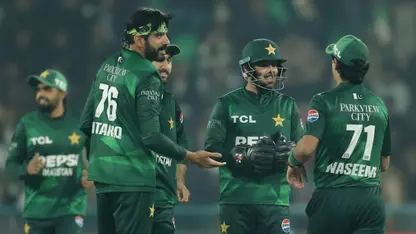

Usman Tariq celebrates a wicket with his teammates (Source: PCB)

Published - 15 Feb 2026, 02:42 PM• Read time - 3 mins
In a fixture where reputations are put to the test as much as skills, Pakistan’s new mystery spinner Usman Tariq enters the India clash on February 15 carrying a weight few newcomers have had to shoulder. He is not just Pakistan’s newest hope in the middle overs; he is also a bowler under constant scrutiny, a talent wrapped in expectation and controversy at the same time.
Tariq’s numbers, at this early stage of his career, are impressive. 11 wickets in four T20Is at an economy rate of 5.93. A T20I hat‑trick already to his name, placing him alongside Faheem Ashraf, Mohammad Hasnain, and Mohammad Nawaz as the only Pakistan players to achieve the feat.

And perhaps most impressively, he has not gone wicketless in his last 23 T20 matches, a streak that speaks to consistency and impact rather than novelty.
His journey to this stage has been anything but conventional. Before ascending the stairs of professional cricket, Tariq worked as a salesman in Dubai, having already given up on his cricketing dream. However, the biopic MS Dhoni: The Untold Story dramatically changed his perspective and rekindled the fire of playing for Pakistan.
HAT-TRICK IN JUST HIS SECOND T20I 🤯🔥
— Pakistan Cricket (@TheRealPCB) November 23, 2025
Usman Tariq shines! Only the fourth Pakistan bowler to claim a T20I hat-trick 👏🇵🇰
📺 Watch live in the UK region, sign up now at https://t.co/Z0RXSR7gYM#CricketKiJeet | #PAKvZIM | #BackTheBoysInGreen pic.twitter.com/hYNVHu7B7j
His most recent outing only strengthened the sense that Pakistan have found something rare. Against the USA in their last T20 World Cup match, Tariq returned 3 for 27, providing significant breakthroughs. It was the sort of spell that could be the difference‑maker against India.
But alongside the promise sits a parallel narrative. Tariq has been reported twice for a suspect action, once in the 2024 PSL and again in 2025. Both times he was cleared, yet the conversation around him has not quietened.
Every pause in his delivery, every angle of his release, every deviation off the surface is analysed with unusual intensity. For an emerging bowler, that level of attention can be as demanding as the cricket itself.
This duality, rising star and heavily scrutinised figure, is what makes his role in the India match so intriguing.
Pakistan have often relied on mystery spin to unsettle India’s batting, and Tariq fits that tradition. His variations, his rhythm, and his ability to attack both edges make him a genuine tactical asset.
Yet the India-Pakistan contest is not just about plans and match‑ups. It is a psychological environment unlike any other in cricket. Even experienced players speak of the noise, the intensity, the scrutiny. For someone at the beginning of his international journey, the challenge is not simply to bowl well; it is to remain unaffected by everything that surrounds the occasion.
Tariq has shown temperament in domestic cricket and in his early international appearances, but the Colombo fixture is on a different scale altogether. The expectations are high, the margin for error is small, and the spotlight is unrelenting. Pakistan need him to disrupt India’s rhythm and absorb pressure without letting it alter his approach.
The question, then, is not whether Tariq has the skillset. His performances already answer that. The real test is whether he can carry the weight of expectation, navigate the scrutiny around his action, and deliver in a match where every over shapes the narrative.
On February 15, Pakistan will look to him not just for wickets, but for calm. And Colombo will reveal whether an emerging spinner with undeniable promise can translate potential into performance on cricket’s most demanding stage.
