


Salman Ali Agha comes of age in Colombo, shuts down noise on game awareness with a tactical 'masterstroke'
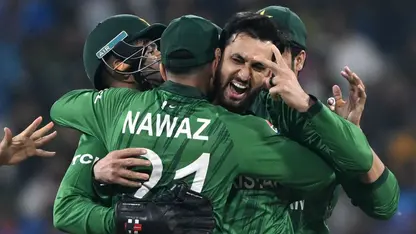

Salman Ali Agha (Source: PCB)

Published - 15 Feb 2026, 06:32 PM• Read time - 2 mins
For months, Salman Ali Agha carried the weight of a single decision, or rather, the absence of one. His captaincy during last year’s Asia Cup in Dubai was dissected relentlessly, but nothing drew more criticism than his decision not to bowl even a single over in the final when India had two left‑handers, Tilak Varma and Shivam Dube, rebuilding after an early collapse. Pakistan had India 20 for 3 chasing 147, the ideal scenario for a right‑arm off‑spinner to attack Tilak. Yet Salman never turned to himself.
Tilak and Dube stitched together a match‑defining 60‑run stand for the fifth wicket. India won in the end, and the post‑mortem was unforgiving. Former Pakistan captain Mohammad Hafeez even expressed his frustration with Salman, calling him out on Twitter.

Captain G ur a off spinner too.. 🤯😇 #asiacup2025final
— Mohammad Hafeez (@MHafeez22) September 28, 2025
Whether Salman would have dismissed either batter was unknowable, but the fact that he never explored the match‑up became the enduring symbol of a captain who, critics argued, failed to read the game.
Fast‑forward to Sunday night in Colombo, and the contrast could not have been sharper. In Pakistan’s T20 World Cup clash against India at the R Premadasa Stadium, Salman looked switched on from the outset, decisive at the toss, clear in his plans, and proactive in his use of himself as a bowling option.
After opting to field first, Salman took the new ball himself and immediately shaped the contest. With India opening through two left‑handers, Ishan Kishan and Abhishek Sharma, he went around the wicket and attacked the stumps. The intent was unmistakable: he was not going to repeat the passivity of Dubai.
The reward came quickly. Salman bowled three consecutive dots to Abhishek, building pressure, before delivering a back‑of‑a‑length ball that skidded on and forced a miscued shot to mid‑on. Shaheen Afridi completed the catch, but the wicket belonged to the captain’s clarity.
His field placements reflected the same sharpness. A deep mid‑wicket offered protection, but he kept mid‑on up instead of pushing him back to long‑on, a calculated invitation for the left‑handers to take the aerial route straight down the ground. Abhishek accepted the bait, and Pakistan profited. Cricketer-turned-broadcaster Ravi Shastri lauded Agha, calling it a "masterstroke" on air.
It was a small moment in the larger context of an India-Pakistan fixture, but a significant one for Salman. It showed a captain willing to learn, willing to trust his instincts, and willing to take responsibility in the moments that matter.
From the hesitation of Dubai to the decisiveness of Colombo, Salman looked like a captain who had come of age.
