


Team India survive the banana slip, steady late to see off USA in major scare
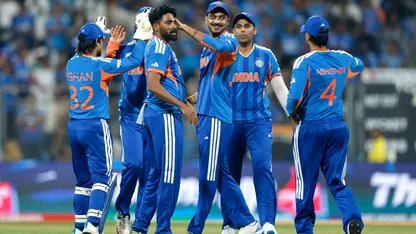

Team India (Source: BCCI)

Published - 07 Feb 2026, 09:53 PM• Read time - 3 mins
India’s T20 World Cup campaign began with far more tension than they would have liked, but they emerged with a 29‑run win that owed everything to Suryakumar Yadav’s composure and a disciplined bowling unit.
What threatened to become an early banana slip, the kind that has haunted India in global tournaments before, was ultimately steadied by experience, clarity, and control at the Wankhede.

USA arrive with a clear, deliberate plan
The USA, with nothing to lose and everything to gain, arrived with a clear plan and executed it with conviction. Their field placements were sharp from the outset, a sweeper cover patrolling the off‑side fence, a square leg in place, and bowlers operating to those fields with discipline.
Ali Khan set the tone with a short ball outside off, tempting Abhishek Sharma into an aerial punch that went straight to the fielder. It was a wicket manufactured through planning rather than chance.
Shadley van Schalkwyk followed the same blueprint. His short delivery outside off climbed awkwardly on Tilak Varma, cramping him for room and forcing a mis‑hit that landed in the hands of Monank Patel. Schalkwyk then out‑thought Shivam Dube with a slower bumper, drawing a top‑edge to short fine leg. The USA clearly dictated the passages of play.
India’s young batters feel the stage
Dube’s dismissal deepened India’s early unease, and the tension seeped into Rinku Singh’s innings. Usually assured in pressure situations, Rinku struggled to find rhythm, labouring to six off 13 balls. His attempt to muscle Mohammad Mohsin over long‑on ended in a simple catch, a reflection of a batting group trying to hit their way out of trouble rather than settling into the surface.
Hardik Pandya and Axar Patel fell similarly, both opting for power over timing and both holing out near the boundary. For a side that had bulldozed New Zealand 4–1 and last lost a T20I series in August 2023, the sudden fraying of composure was striking.
The aura they carried into the tournament seemed to dissipate under the weight of a World Cup stage, a reminder that bilateral dominance does not automatically translate to global events.
The younger batters, in particular, looked tentative. The fear of failure, absent in recent months, crept into their shot selection and tempo. India’s innings, once expected to be a statement of authority, instead became a test of temperament.
Suryakumar steadies, bowlers seal the escape
Through the turbulence, Suryakumar Yadav held India together. His innings was not the free‑flowing exhibition he is known for, but a measured, responsible effort that recognised the moment. He absorbed pressure, rebuilt the innings, and ensured India had a total their bowlers could work with. And the bowlers responded exactly as he needed them to.
Arshdeep Singh (2/18) struck early and kept the USA openers in check. Varun Chakravarthy (1/24) applied the squeeze through the middle overs, while Axar Patel (2/24) chipped away with crucial breakthroughs. But it was Mohammed Siraj who stood tallest, finishing with 3/29 and breaking the USA’s resistance whenever it threatened to grow.
Their combined discipline ensured India avoided a far more damaging storyline, one that would have echoed the banana slip of the 2007 ODI World Cup, when a shock defeat to Bangladesh derailed their campaign before it had begun.
A scare survived, lessons banked
India’s win will go down as a comfortable margin on paper, but the contest was anything but. The USA exposed nerves, unsettled India’s batting order, and forced the favourites to dig deeper than expected in their opening game.
In the end, India survived the banana slip. But the wobble was real, and the lessons will be valuable as the tournament gathers pace.
