


Why now, Usman? Will these belated sandpaper allegations help de-villainise Bancroft, Warner and Smith?
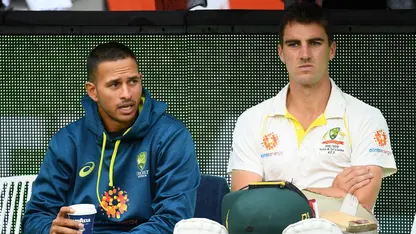

Usman Khawaja and Pat Cummins (Source: Getty Images)

Published - 13 Nov 2026, 08:41 PM• Read time - 3 mins
Cricket is a team sport that demands 11 individuals, each with a unique personality and perspective, to pull in the same direction in pursuit of a common objective. Yet that is precisely what makes the game so complex. Every player arrives with a different upbringing and a different relationship with the sport.
Stories of dressing-room friction, therefore, rarely come as a surprise. Even some of the greatest teams have endured internal conflicts, whether it was the Virender Sehwag-MS Dhoni saga in India or the fallout between Michael Clarke and Shane Watson in Australia. Very few sides have appeared immune to such divisions, and Pat Cummins' Australia seemed to be one of them until Usman Khawaja decided to present his version of the Sandpapergate controversy.
A relationship that survived former head coach Justin Langer's unceremonious departure now appears fractured beyond repair, with Australian cricket seemingly split into two camps. Khawaja and David Warner are on one side, alleging Australia tampered with the ball in Gqeberha before being caught on camera in Cape Town. Their most explosive claim, however, is that every member of Australia's touring party knew sandpaper was being used to alter the condition of the ball.
Cummins responded to those allegations on Friday, dismissing them as "complete and utter nonsense". Yet even if Khawaja's version of events is accurate, and even if the full truth behind Australia's darkest cricketing chapter eventually emerges, it is difficult to see how it would materially alter the legacies of the three men most affected by the scandal.
Did Khawaja's sandpaper bombshell change anything?
Take Cameron Bancroft, for instance. He was a 25-year-old batter desperately trying to secure his place in Australia's Test side and has repeatedly stated that this was one of the reasons he agreed to participate in the ball-tampering plan in Cape Town.
Bancroft served a nine-month suspension following the incident and, although he did return to the Test arena, he was never quite the same player again. Now 33, his chances of earning another Test recall appear slimmer than ever.
As for Steve Smith, Khawaja's claims are unlikely to restore what was lost. Smith was at the height of his powers in 2018 and seemed destined to captain Australia for years. Even if Khawaja's allegations are proven true, one fact remains unchanged: Smith, as captain, approved the plan to tamper with the ball.
In fact, the allegations could have the opposite effect. Rather than easing scrutiny, they may reopen old wounds and ensure that questions about Sandpapergate once again follow Smith through the closing years of his international career. Journalists are also likely to ask why Khawaja was allegedly prevented from sharing his side of the story sooner.
Warner's situation is different. Having already retired from international cricket, he no longer has a playing career to protect. What these allegations may have done, however, is further strain relationships with some of his former teammates. His public backing of Khawaja has only deepened the divide, particularly after his sharp response to Cummins' dismissal of the claims.
"I actually feel that the captain [Cummins] today threw Uzzie [Usman Khawaja] under the bus, and I'm very, very disappointed by that," Warner said on Fox while reacting to Cummins' remarks.
Judging by the intensity of Cummins' rebuttal and Warner's reaction to the same, it would be no surprise if a Christmas card from Cummins fails to find its way into Warner's mailbox this year.