


Why India failed to get Joe Root out in the ODI series?
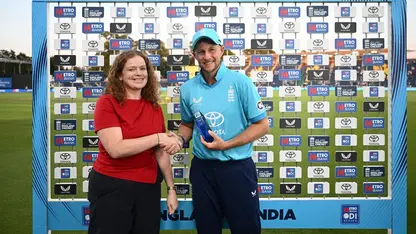

Joe Root receives the Player of the Match award (Source: Getty Images)

Published - 19 Jul 2026, 09:14 PM• Read time - 12 mins
A nightmare, a roadblock, an immovable object: Joe Root was all of these and arguably much more to India in the three‑match ODI series. He finished the contest with 249 runs at an average of infinity, as India never managed to dismiss him even once. And it wasn’t a case of repeated chances going down; Root offered just a single opportunity when he was on 7 off 10 in the series opener at Edgbaston.
Let’s take a deep dive into what made Root invincible this series and why India failed to get him out.
Supreme ability to manipulate the field
Chasing 234 in the second ODI to stay alive in the series, England were tottering at 24/2 in 6.3 overs. India had dismissed Jacob Bethell and Ben Duckett, and Root was struggling to break free.
But his supreme ability to manipulate the field came to the fore. He shuffled towards off‑stump to a fullish delivery on middle from Jasprit Bumrah and whipped it to the square‑leg fence for four.
It wasn’t a one‑off.
On the second ball of the next over from Prasidh Krishna, Root judged the trajectory early, shuffled across, met the ball on the full, and flicked it into the vacant backward‑square region for another boundary. Had he missed, his innings would have ended, but Root relied on his hand‑eye coordination to pull off what looked like a highly risky shot for a boundary.
Another perfect example came in the 27th over of the first ODI against Axar Patel. With a short third in place, slightly wider than usual, Root recognised the positioning and went for a reverse sweep, more of a paddle, delicately placing the ball fine using the pace. Had he muscled it, the fielder would have been in play, but Root was too shrewd to make that mistake.
Ability to rotate the strike with ease
Root’s excellence in ODIs lies in his effortless strike rotation, with third man his most productive region. Particularly, in Cardiff, under pressure, he relied on his dab to the third man to keep the scoreboard ticking.
On the third ball of the fourth over, India had a gully and slip in place to squeeze the gap, yet Root threaded it for a single.
India needed either to plug that gap with a short third or force him to target other areas. They didn’t, and Root kept running it down to third man, never allowing pressure to build.
India’s lack of homework
Root’s wagon wheel in this series shows nine fours on the off‑side, all in the third‑man region. That highlights two facets:
a) Indian bowlers weren’t full enough outside off to draw Root forward into drives through cover or mid‑off. Root thrives on the back foot, and India needed to tempt him forward to nick him off to the keeper or in the slip cordon.
b) The Men in Blue kept feeding balls to Root in his area of strength, which is either short-pitched stuff or short of good length. The former England captain can roll his wrists over while playing the pull, which helps him keep the ball on the ground and doesn't bring the boundary riders into play.
India’s costly error of not playing Kuldeep Yadav
India tested Root with a one‑dimensional attack of right‑arm pacers: Bumrah, Gurnoor Brar, Prasidh Krishna, and Prince Yadav. Root settled into the angle and knew what to expect. He faced just 11 balls from Arshdeep Singh, hardly enough to trouble him.
Against Washington Sundar and Axar Patel, both finger spinners, Root was never threatened as they extracted little turn throughout the series.
The decision not to unleash Kuldeep Yadav worked in Root’s favour. Kuldeep, a left‑arm wrist spinner, is a rare breed and difficult to score against. He was also one of only three bowlers on tour with prior experience of playing ODIs in England.
None of Prince, Arshdeep, Gurnoor, Sundar, or Shivam Dube had played an ODI in England before, and it showed.
Kuldeep Yadav's record in England
| Format | Innings | Overs | Maidens | Runs Conceded | Wickets | Average | Economy Rate | Best Bowling (BBI) |
|---|---|---|---|---|---|---|---|---|
| ODIs | 10 | 97 | 2 | 485 | 15 | 32.33 | 5.00 | 6/25 (10) vs England at Nottingham, 2018 |
| T20Is | 2 | 8 | – | 58 | 5 | 11.60 | 7.25 | 5/24 (4) vs England at Manchester, 2018 |
Root teaches the art of batting in ODIs
In an era where T20 cricket influences every format, Root reminded everyone that ODI batting in English conditions is about getting the job done, not playing for the gallery. Despite remaining unbeaten across the series and batting through all phases, from powerplay to death, he hit just one six.
| Statistic | Value |
|---|---|
| Total runs scored | 249 |
| Total balls faced | 257 |
| Dot balls faced | 96 |
| Singles | 126 |
| Twos | 9 |
| Threes | 1 |
| Fours | 24 |
| Sixes | 1 |
| Strike Rate | 96.89 |
Root has the repertoire to pepper boundaries like his contemporaries, but his belief in textbook cricket, manipulating the field, and “doing it ugly” to get his team over the line, as he did in Cardiff, requires a temperament few possess.