


Technical deconstruction of Pakistan's record collapse to India in Women's Asia Cup
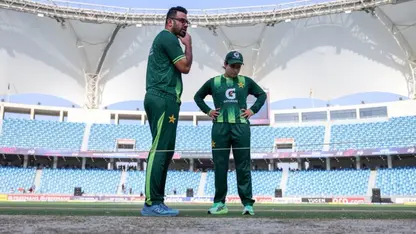

Wahab Riaz and Fatima Sana (Source: PCB)

Published - 06 Sep 2026, 01:28 PM• Read time - 3 mins
Handshake has become a major talking point whenever India and Pakistan take the field against each other following their kinetic conflict in May last year. It resurfaced, with several journalists directing the same question to the Indian team management in the lead‑up to the Pakistan game in the Women's Asia Cup, only for it to be deflected each time.
The internet erupted the moment Harmanpreet Kaur and Fatima Sana did not shake hands at the toss, a precursor to the storm that soon engulfed Pakistan. The Fatima Sana‑led side entered the fixture under immense pressure. They had already lost twice (ODI World Cup and T20 World Cup) to India since the skirmish, and their last win over the Women in Blue in the Asia Cup was 1430 days ago, on October 7, 2022, in Sylhet.
Pakistan won an important toss, as posting a total on a spin‑friendly surface in hot, humid conditions would have allowed them to apply early pressure on India. They began tentatively but promisingly, with Muneeba Ali and Shawaal Zulfiqar adding 27 in 4.2 overs.
It proved to be the most tranquil phase of Pakistan’s innings, because what followed was an implosion. Muneeba Ali backed away, attempted to open up the off‑side against Shafali Verma, but misread the length, trying to cut a ball she should have played down the ground, and lost her woodwork.
Harmanpreet then demonstrated why she is the most-capped captain, man or woman, in the format. She introduced N Sree Charani for the final over of the powerplay. It was a calculated ploy: dangle the carrot, tempt Pakistan into attacking the No. 1‑ranked T20I bowler during the last over of field restrictions, and lure them off their plan. Pakistan took the bait and veered off course.
Pakistan’s capitulation began with Gull Feroza’s dismissal. The right‑hander charged down the track to a conventional left‑arm off‑spin delivery but failed to meet it on the full due to the dip. The ball turned, took the outside half of her bat as she attempted to launch it leg-side, and Nandini Sharma at short third moved to her right to complete a straightforward chance.
Shawaal Zulfiqar, Pakistan’s top scorer (14), committed a similar tactical error. She attempted to sweep a ball, not that full, against Sree Charani instead of playing with the turn on the off‑side with a full face of the bat. Zulfiqar played around the delivery and was trapped stone dead in front. The underlying lesson in Feroza and Zulfiqar’s dismissals went unheeded, as Ayesha Zafar repeated the same mistake, allowing Sree Charani to claim her third wicket.
Ayesha’s dismissal encapsulated Pakistan’s lack of game awareness. She received an innocuous, tossed‑up delivery outside off stump, and instead of choosing the safer route down the ground or over cover, Pakistan’s No. 4 went against the turn and picked out Harmanpreet on the edge of the 25‑yard circle.
Three frontline batters, one recurring tactical error, and Pakistan plunged into a bottomless chasm. Even the lower order, Sadaf Shamas and Umm‑e‑Hani, succumbed to the same flaw, losing their wickets hitting across the line to leg‑spinner Prema Rawat.
Pakistan folded for their lowest‑ever T20I score, leaving coach‑mentor Wahab Riaz with little to do but lament the shot selection.
"See, again, that is what pressure is which makes you take the wrong decisions at the wrong time," Wahab said while responding to a question on the dismissals by Mr Cricket UAE at the post-match press conference.
"I think both the balls, if I compare Gull Feroza and Ayesha Zafar ball, it was right in the slot to hit straight down the ground instead of going cross. And their way, they just missed the trick. I think if they were more confident enough, they should have played it over the covers or over mid-off to score those runs.
"But playing those balls on the on-side, that shows that they were under pressure and they were not making the right decision at the right time."