


What is DLS in cricket and how does it work?
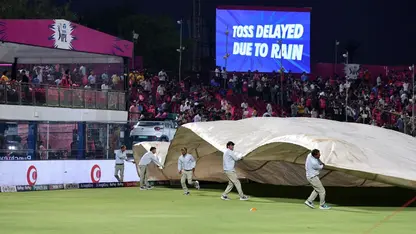

Match delayed by rain in the IPL (Source: Getty Images)

Published - 09 Jul 2026, 05:42 AM• Read time - 4 mins
Ever since the advent of ODIs and the commercialisation of the format, cricket has faced a big challenge due to the inclement weather affecting matches. With cricket being a sport that can’t be played indoors, the International Cricket Council (ICC) had to come up with a solution to ensure that rain breaks don’t leave any team at a disadvantage, while preserving the excitement of the game for its growing fanbase.
To counter this problem, two English statisticians, Frank Duckworth and Tony Lewis, came up with the Duckworth–Lewis method (D/L). The controversial end of the 1992 World Cup semi-final between South Africa and England sowed the seeds for the invention of the D/L method.
South Africa needed 22 runs from 13 balls when the rain stopped play during the match. However, when play resumed, the revised target set as per the ‘rain rule’ left them requiring 21 runs from just one delivery. The bizarre scenes led to Duckworth working towards a mathematical solution to counter the glaring issue.
The D/L method was introduced in 1997 and was officially adopted by the International Cricket Council (ICC) in 1999.
Also Read: DRS Explained: How the Decision Review System works in cricket
When was DLS used for first time?
It made its international debut on 1 January 1997 during the second ODI between Zimbabwe and England, with Zimbabwe winning the rain-affected contest by seven runs. Following the retirement of its creators, Frank Duckworth and Tony Lewis, Australian statistician Steven Stern took over as its custodian.
In November 2014, the system was renamed the Duckworth-Lewis-Stern (DLS) method after Stern refined the model as per modern scoring patterns largely affected by T20 cricket. The DLS method continues to be used to determine targets in rain-affected international matches.
How DLS calculates target in rain-affected match?
The Duckworth-Lewis-Stern (DLS) method is based on the principle that a batting side begins an innings with two key resources: balls and 10 wickets. As the innings progresses, both resources diminish, eventually reaching zero when the team either completes its allotted deliveries or loses all 10 wickets.
If a team's innings is shortened due to interruptions such as rain, it loses the opportunity to fully utilise those resources. The DLS method compensates for this by revising the target according to the proportion of resources available to each team, ensuring a fair result despite the reduced number of overs. DLS is only used in limited-overs cricket, i.e T20Is and ODIs, and Test cricket remains unaffected by it.
How is DLS applied at different stages of a match?
For example, in a 20-over match, if rain interrupts at the 10-over mark, then the batting team will be compensated for the loss of overs in case of a shortened match, depending upon the number of wickets lost at the time of the weather interruption. If the weather doesn't permit a full 20-over fixture, then the score for the team batting first would be re-adjusted for the shortened fixture.
In case a team isn't able to bat its entire 20 overs and the chasing team is given full 20 overs to complete the target, the final score for the team batting first would again be calculated using the DLS method, which would take into account both their run rate at the time of interruption and the number of wickets in hand.
Wickets remain the most important commodity in rain-affected matches, as teams having more batters ready to bat in the pavilion at the time of interruption benefit from the DLS method.
What is a DLS par score?
For teams batting second during a run chase in a rain-affected game, DLS comes into effect after a minimum number of overs have been bowled, which is 20 in ODIs and five in T20Is. As soon as the minimum threshold of overs is completed to determine a result in a game, a DLS par score is calculated after every subsequent ball, which varies according to the team’s run rate and the wickets lost.
For a chasing team in a rain-affected match, it has to level the DLS par score to tie the game and score a run extra to claim a victory. During the 2003 World Cup, South Africa’s lack of awareness regarding this rule led to their exit from the tournament in the group stage itself.