


What is Reverse Swing in cricket and how does it work?
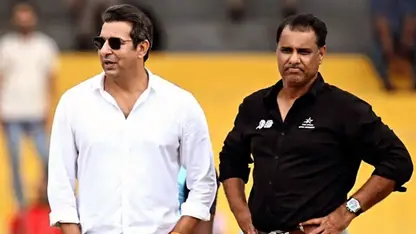

Wasim Akram, Waqar Younis (Source: Instagram/@waqyounis)

Published - 07 Jul 2026, 05:46 AM• Read time - 2 mins
In cricket, the ability to swing the ball remains one of the most respected arts of a fast bowler, making them a dangerous prospect across all conditions. Swing makes a cricket ball curve in the air, which often deceives the batter and induces a false shot.
There are generally two types of swing bowling: in-swing, where the ball curves in towards the batter and out-swing, where the ball curves outwards. However, there’s another type called reverse-swing, which isn’t mastered by most bowlers.
Reverse swing remains a unique trait in the bowler’s arsenal, and batters often find it much more difficult to counter than the regular swing. The conventional swing happens when the ball is still new, and one side is noticeably shinier than the other.
How does reverse swing work?
As air flows differently over the shiny and rough sides, the ball moves towards the rough side while in the air and away from the shiny side. Swing bowlers often make slight adjustments to their grip and seam position to enhance this movement and outfox the batters.
Reverse swing, on the other hand, occurs with an older, more worn-out ball, and it moves in the opposite direction towards the shiny side instead of the rough side.
Why is reverse swing difficult to play?
In some cases, it begins with a conventional swing before altering its movement as it nears the batter. The ball may also reverse its direction of swing, or it may continue swinging in the same direction but with much more movement.
Both variations can be extremely difficult for a batter to handle. A sudden change in direction can leave the batter committed to the wrong shot, while an unexpected increase in swing can beat their technique and lead to dismissals such as LBW, bowled, or caught behind.
Which bowlers are famous for reverse swing?
Saleem Mir is credited with developing the art of reverse swing, according to former Pakistan Cricket Board (PCB) chairman Shaharyar Khan. Mir played for the Punjab Cricket Club in Lahore during the late 1960s and taught the skill to his teammate Sarfraz Nawaz, who introduced reverse swing to international cricket in the late 1970s.
Nawaz then passed the technique on to his teammate Imran Khan, who helped popularise it further by mentoring the legendary fast-bowling pair of Wasim Akram and Waqar Younis, the duo touted as one of the most formidable pacers in history. The reverse swing was also extensively employed by India’s Zaheer Khan, England’s Andrew Flintoff and James Anderson, among other modern-day bowlers.