


What is UltraEdge in cricket? How it works and why it is used
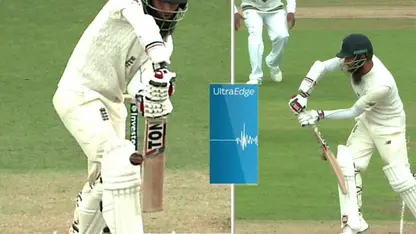

Utra Edge Technology in use (Source: X/@SkyCricket)

Published - 23 Jul 2026, 05:58 AM• Read time - 3 mins
In the late 2000s, there was a growing need for technology to ensure that the correct decisions were made on the cricket pitch. Over the years, there have been several instances where players were wrongly given out despite not edging the ball or were allowed to continue their innings even after getting caught behind as umpires failed to hear the edge.
To counter these instances and bring more transparency in the decision-making process, the Snickometer was introduced. It’s a technology used to help determine potential dismissals, such as catches behind the wicket, close-in catches or leg before wicket (LBW).
When was Ultra Edge introduced?
The original Snickometer was invented by British computer scientist Allan Plaskett and was first used by the UK's Channel 4 during cricket broadcasts in 1999.
Later, the Snickometer was replaced with Ultra Edge in 2015, which is an advanced version of the same technology designed by HawkEye to detect faint edges between the bat and ball with greater accuracy.
The technology was rigorously evaluated by engineers at the Massachusetts Institute of Technology (MIT), ensuring its accuracy and reliability before being incorporated into the Decision Review System (DRS).
Following extensive testing and verification, UltraEdge was approved for use by the International Cricket Council (ICC).
How does Ultra Edge work?
UltraEdge works by displaying a frame-by-frame replay of the ball passing the bat alongside an audio waveform generated by a sensitive microphone placed near the stumps. Any spike in the waveform can indicate contact between the ball and the bat.
UltraEdge combines audio and visual technology to detect whether the ball has made contact with the bat. It uses highly sensitive microphones installed inside the stumps along with multiple high-speed cameras positioned around the ground. When the ball passes the bat, any contact generates a distinct sound that is captured by the stump microphones and displayed as a spike on the tracking screen.
The technology is designed to distinguish between sounds produced by the bat, pad and other nearby objects, helping match officials identify genuine edges.
At the same time, cameras at either end of the ground provide a frame-by-frame visual of the ball's trajectory, while the audio captured by the stump microphones is converted into a waveform on an oscilloscope. By synchronising the sound and video, UltraEdge enables the third umpire to determine whether the ball has nicked the bat before carrying to the wicketkeeper or fielders.
Controversies with UltraEdge
However, there have been at times some controversial decisions given despite the use of UltraEdge. On a few occasions, a spike appears in the sound wave lengths, even before the ball touches the bat. This usually happens when the mic catches external sounds at the time of the ball being released from the bowler’s hand.
In some cases, when a player’s bat hits the ground and edges the ball at the same time, the sound detected can create confusion, making it difficult for the third umpire to give the correct decision. On other occasions, when the ball makes contact with the bat and also brushes the pad at the same time, it again makes it difficult for the third umpire to determine what made first contact with the ball, which has a big influence on the decision-making.