


IPL 2026: Why batting first with rain on the radar rarely yields a winning formula?
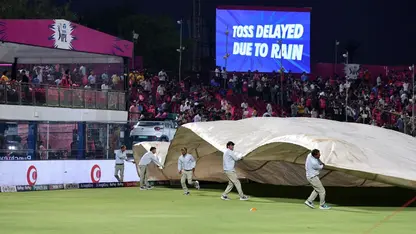

Match delayed by rain in the IPL (Source: Getty Images)

Published - 08 Apr 2026, 07:13 PM• Read time - 3 mins
When Ajinkya Rahane won the toss and elected to bat against Punjab Kings at Eden Gardens on April 6, it raised more than a few eyebrows. The wicket had been under covers due to persistent showers, the forecast promised more rain during the contest, and yet Kolkata Knight Riders chose to bat.

When you know it’s going to be a rain affected game, with an inexperienced bowling attack at your disposal, you choose to bat first.
— Ashwin 🇮🇳 (@ashwinravi99) April 6, 2026
Interesting thought process. #ipl2026 pic.twitter.com/uPWQB7Odfr
Ravichandran Ashwin called it an “interesting thought process.” Aaron Finch was far less diplomatic, branding it “absolutely no sense” on ESPNcricinfo Timeout. Finch’s critique cut to the heart of the matter:
“Winning the toss and electing to bat after the wicket’s been under covers for a day, you know that there’s rain in the air. It makes absolutely no sense… That’s like a play that’s out of form as well, isn’t it? You can tell when somebody’s mind is a little bit scrambled.”
To a casual fan, this may sound like an overreaction to a coin flip. But in rain‑curtailed games, the toss is anything but trivial. Since the inception of the IPL in 2008, teams batting first in truncated contests have won only eight times, while chasing sides have triumphed 17 times. The numbers tell the story: batting first under looming rain clouds is a gamble stacked against you.
Why is batting first a disadvantage?
The logic is simple yet brutal. A team batting first must approach its innings as if it will last the full 20 overs. That was KKR’s mindset against Punjab. They lost Finn Allen and Cameron Green early, slumping to 25/2 before rain halted play.
Had the game resumed as a five‑over shootout, KKR would have had just eight more balls to bash and set a target. Their innings, built for 20 overs, would have been misaligned with the revised scenario.
By contrast, the chasing side enjoys clarity. Every over comes with a revised target under the Duckworth–Lewis–Stern method, allowing batters to plan risks with precision. They know exactly what is required, whether the game lasts 10 overs, eight overs, or even shrinks further to a five-over fixture. That clarity is priceless in a format where margins are razor‑thin.
KKR were fortunate that the game never restarted. With their inexperienced attack missing Sunil Narine and Varun Chakravarthy, defending a modest rain‑adjusted total against Punjab’s power‑packed batting line‑up would have been near impossible.
The Rajasthan-Mumbai case study
A day later in Guwahati, Rajasthan Royals hosted Mumbai Indians in another rain‑affected clash. This time, the game began as an 11‑over per side fixture. Mumbai won the toss and wisely chose to field. Rajasthan piled on 150/3 in their allotted overs and restricted Mumbai to 123/9.
At first glance, this result seems to contradict the theory; the chasing side lost.
But the nuance matters. The game never began as a 20‑over contest; it started as an 11‑over fixture. Mumbai never had the advantage of a mid‑match reduction, which is where chasing sides usually benefit. Had the game shrunk further from 11 overs, Mumbai would have gained clarity and a revised target. Because it remained static, Rajasthan’s batting first strategy was not penalized.
The broader truth
Rain doesn’t just shorten games; it distorts them. Batting first forces a team to play blind, preparing for 20 overs without knowing how many they’ll actually get. Chasing sides, however, are armed with information, revised targets, clarity of overs, and the ability to attack with purpose.
That is why experts bristle when captains elect to bat under heavy rain forecasts. It’s not conservatism; it’s pragmatism. The data, the psychology, and the tactical realities all point one way: in rain‑curtailed contests, chasing is king.
Rahane’s call at Eden Gardens was more than a toss decision. It was a reminder that in modern T20 cricket, controlling the controllables matters. And when rain looms, the biggest controllable is choosing to chase.
