


Delhi Capitals' topsy-turvy IPL 2026 season casts doubts over Axar Patel's leadership future for Team India
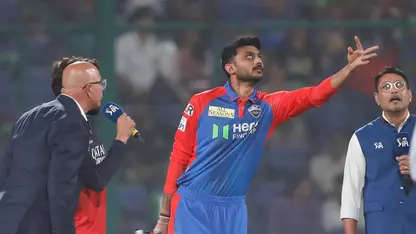

Axar Patel (Source: Getty Images)

Published - 08 May 2026, 11:50 AM• Read time - 3 mins
Delhi Capitals (DC) came into IPL 2026 still burdened by the “underachiever” tag that has shadowed them since the league’s inception in 2008. 50 games into the season, and that narrative remains intact. With only four wins in their first 10 outings and six defeats, Delhi are already in must‑win territory to keep playoff hopes alive.
For Axar Patel, however, the stakes were far greater than just Delhi’s campaign. IPL 2026 was meant to be his audition for India’s future T20I captaincy.
Axar Patel's journey as Team India's vice captain
Axar’s leadership journey has been turbulent. When Shubman Gill was elevated to India’s T20I vice‑captaincy ahead of the Asia Cup last year, Axar was demoted despite serving as Suryakumar Yadav’s deputy for a long stretch. Gill’s failure to cement his spot saw Axar reinstated, and he repaid the faith spectacularly at the ICC Men’s T20 World Cup 2026.
Axar bagged 11 wickets in seven matches, at an economy of 8.20, and an average of 18.63, playing a pivotal role in India’s successful title defence.
That performance positioned him as a prime candidate to succeed Suryakumar, who at 35 may not lead India into the next cycle.
IPL 2026: A crucible for Axar’s leadership
If the World Cup showcased Axar as India’s dependable vice-captain, IPL 2026 has been the crucible where his captaincy credentials have truly been tested. The numbers are stark: 10 matches, 4 wins, 6 losses, translating to a 40% win rate and 60% loss rate. His overall record as DC captain across seasons is not much brighter: 23 matches, 10 wins, 12 losses, 1 NR: 43.48% win rate, and a 52.17% loss rate.
But numbers alone don’t tell the full story. Delhi’s campaign has been punctuated by moments where Axar’s leadership was expected to shine, yet the execution fell short. His batting returns, 33 runs across seven innings at a strike rate of 89.18, have been modest, leaving Delhi without the lower‑order impetus that an allrounder‑captain is often expected to provide.
In a season where batters have dominated bowlers, such returns have amplified the perception of a captain unable to lead from the front with the bat.
With the ball, Axar has fared better. His nine wickets at an economy of 8.25 reflect control in a season where bowlers have been routinely carted around. Yet, even here, the impact has been steady rather than decisive.
The hallmark of a captain‑bowler is often the ability to turn games with a spell under pressure; Axar’s wickets have not always carried that match‑defining weight.
Axar's questionable act as DC captain
The tactical dimension has been equally scrutinised. Match 31 of this season against Sunrisers Hyderabad stands out as a case study. SRH opener Abhishek Sharma was in rampaging form, dismantling Delhi’s attack. Despite a favourable head‑to‑head record (two dismissals for just six runs), Axar bowled only two overs, choosing not to challenge Abhishek further.
He did dismiss Travis Head, but the reluctance to bowl himself against Abhishek allowed SRH to post a towering 242. For a captain, such decisions are magnified as they shape instinct and willingness to seize the moment.
Taken together, IPL 2026 has been less about Axar’s failures and more about missed opportunities. In a season where Delhi needed to shed the "underschiever" tag, Axar’s stewardship has kept them afloat without steering them clear of mediocrity.
Axar remains India’s T20I vice‑captain, and his World Cup exploits underline his value as a bowling allrounder. But IPL 2026 has not strengthened his case for captaincy. His win percentage for DC, subdued batting, and occasional tactical lapses suggest that while he is a dependable lieutenant, the aura of a leader who commands authority is yet to emerge.
For India’s selectors, the dilemma is clear: Axar has the pedigree, but IPL 2026 has not provided enough evidence to elevate him beyond the role of deputy.