


SRH pacers dish out bowling masterclass on a flat deck to school RCB ahead of IPL 2026 playoffs
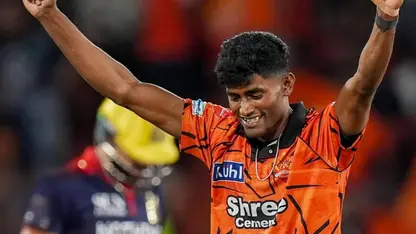

Sakib Hussain celebrates Virat Kohli's wicket (Source: BCCI/IPL)

Published - 23 May 2026, 11:49 AM• Read time - 4 mins
A lot was riding on Match No. 67 when Sunrisers Hyderabad (SRH) hosted Royal Challengers Bengaluru (RCB) at the Rajiv Gandhi International Stadium on May 22.
It was an invaluable opportunity for both teams to lock the remaining top‑two spot and earn a berth in Qualifier 1. SRH captain Pat Cummins meant business when the coin fell his way, opting to bat first and put RCB under the pump.
His batters followed suit, posting a mammoth 255. In reply, RCB looked interested in chasing initially but soon raised the white flag, focusing instead on the magical number of 166. They eventually finished at 200, securing their top‑two place and a meeting with Gujarat Titans (GT) in Qualifier 1.
For those new to the IPL, Qualifier 1 offers an extra lifeline: even if a team slips once, they get another shot at the silverware instead of facing immediate elimination.
But the game was more than playoff arithmetic. Most importantly, it showcased how SRH’s pacers delivered a bowling masterclass on a wicket as flat as a pancake, and a valuable lesson for RCB with the playoffs looming large.
RCB’s pace‑on plan falters
The contest began with the famed new‑ball pairing of Bhuvneshwar Kumar and Josh Hazlewood steaming in tandem, probing good lengths and searching for sideways movement with the new Kookaburra.
Bhuvneshwar’s second delivery was marginally short of a good length. For Travis Head, who usually sits deep in his crease and rarely commits forward, it sat up perfectly; he carved it through point for four.
The penultimate ball of the first over confirmed the lack of lateral movement. Bhuvneshwar bowled another length delivery, aiming to take it away from Abhishek Sharma. But with no swing, Abhishek pressed forward and hit through the line, lofting it over mid‑off for six, almost nonchalantly.
Hazlewood’s first over mixed length, back‑of‑a‑length, and fuller deliveries in search of movement before trying a short ball on leg and his compatriot helped it away through mid‑wicket for four.
By the third over, Bhuvneshwar was still probing. His fuller ball on the leg stump was flicked for four by Abhishek. Next, a length ball on middle and leg was again flicked through mid‑wicket for another boundary.
It was clear by then: pace‑on was not the way to operate on that deck. Hazlewood’s 13th over proved costly when he tried to defy it. He began with a length ball, slightly fuller, which Ishan Kishan toe‑ended to deep cover. Next, a fuller delivery on middle and leg cramped Heinrich Klaasen, but the South African cleared his front leg and deposited it over cow corner for six.
Hazlewood repeated the mistake, pace‑on, length, off‑stump, and Klaasen went downtown for a 93‑metre six. He followed it up with a wide yorker, but Klaasen stretched out and pierced the gap between short third and point for four. The penultimate ball, a knee‑high full toss, was cleared over long‑on for another six as Hazlewood leaked 27 in the over.
It was evident that the RCB pacers failed to identify a Plan B when their Plan A: length, swing, and seam, faltered.
SRH bowling: Pace‑off masterclass
At half‑time, SRH’s 255 looked chaseable on such a flat deck. But what unfolded in RCB’s innings was a clinic in how to bowl on a placid track.
The highlight came in the last over of RCB’s powerplay, bowled by youngster Sakib Hussain.
- First ball: pace‑off, length, to Devdutt Padikkal, guided to covers for a single.
- Second: slower, full around off, Kohli attempted his trademark whip, mistimed, and settled for one.
- Third: slower, fullish on middle, Padikkal nudged to mid‑on for another single.
- Fourth: slower, full outside off, in Kohli’s arc, but his full‑blooded drive was intercepted at cover.
- Fifth: slower again, fullish length, inviting Kohli to drive and the former RCB captain couldn't resist the temptation. He went through with the shot, failed to keep it down, and found the fielder at cover.
Five consecutive slower balls, with plenty of conviction, and it resulted in the prized wicket of Kohli.
As the night wore on, Sakib, Eshan Malinga, and Cummins kept mixing slower deliveries and bumpers into the surface. By starving RCB batters of pace, they forced them to generate their own power. The ball never sat up perfectly for the RCB batters, as the SRH pacers denied them clean hits through the line.
The plan not to feed RCB batters pace proved decisive. On a benign surface, SRH’s bowlers gave a clinic: pace‑off was the only way to succeed, a lesson RCB’s attack must take note of.
SRH’s triumph was built not just on runs but on tactical clarity. Their pacers showed guile beats speed on a flat deck. RCB, persisting without adaptation, learned the hard way that in T20 cricket, failing to adjust can often be fatal.